This Blog posting is a sub-post of the larger India Trip blog. To see the entire range of posts, follow this link. Rhodesriders.com
Prior to my trip, I scoured the interwebs in search of intel on bike touring in India. I found very little. Obviously, very few people choose to tour India by bike, and those who do are often riding multi-year adventures headed around the world. These riders are most typically heading West and fly into New Delhi, forced to skip the currently closed or unsafe areas of Afghanistan and Pakistan. Dropping into one of the largest and most bike-unfriendly cities of the world, with a population approaching 34 million people, these riders are quickly overwhelmed and their blogs reflect the shock. One is forced to read between the lines since their blog descriptions are thin. This reflects an unwritten rule all of us feel when describing a place we are touring: “say something nice or say nothing at all.” After all, we are guests in the country, and no one told us that biking there was a reasonable idea.
With that background and writing specifically for those who might consider bike touring in India, I thought I’d take a minute to share some of the steep learning curve we experienced. This will be necessarily technical and likely not of interest to the non-touring public. There will also be some repetition from my previous blog postings,so the intel is found all in one place.
First, Go! India is infinitely rideable. There are challenges, like any place, but these are manageable and the rewards are great. Most of our days offered truly excellent cycling, and the food and warmth of locals make this one of the great undiscovered landscapes you can travel. Having said that, this is expert cycling country. I wouldn’t make this my first destination if you are new to touring. But if you have toured other countries and feel your skills are solid, there is no reason that India shouldn’t be at the top of your list.

Where to go? I would head to Rajasthan and Gujarat as my top Indian destinations. Gujarat is much flatter and the people and small villages are close together. The food is one of the very best regional cuisines in a country full to brimming with exceptional nourishment. On a future trip, I hope to tour the seacoast of Gujarat and some of the desert region abutting Pakistan. Rajasthan, on the other hand, offers more mountainous landscape and this can be a joy for cyclists. The villages are also close together and the roads thinly trafficked. The locals were especially kind and welcoming and even the women had enough confidence to greet strangers warmly. The architectural sights are world renown, and one could easily lose weeks exploring the deep history of the exquisitely crafted built environment.
Another region I traveled extensively in 2016 and would highly recommend is Karnataka and the Western Ghats. This area is filled with 1000-year-old temples beyond compare, lightly visited, and has excellent road surfaces and good hilly terrain. The food is rice-based, not wheat like the north, and although delicious, to my Northern American palate, I found it a little thin.
I rode the area around the Allora and Ajanta cave complexes in the province of Maharashtra in 2015 and found the UNESCO sites some of the best I’ve seen anywhere in the world. Having said that, the touring landscape was less compelling and the villages further apart.
Many cyclists are attracted to the high mountain passes (some of the highest in the world) in the North of India. That is not my thing.
I am interested in exploring the far East of India, the other side of Bangladesh, as well as riding the coastline of the very south eastern tip and around the horn to the south and west. This is the province of Tamil Nadu and is reportedly one of the most scenic areas of all India.
How to Ride India? First, avoid the cities at all costs. Fly into wherever is closest to your target and take the train to your starting “small city.” Matt was able to get a flight into Ahmedabad from London. He changed planes in Mumbai and they transferred his international luggage without issue. He had his bike in a big bike case, and it sailed right through. From the US, I struggled to find a carrier that would include my follow-on destination on the same ticket. Without that, you can’t really make it work. Indian domestic airlines are incredibly inexpensive ($30 tickets are not uncommon), but you can’t get your luggage on the plane without huge fees (upwards of $300 for a bike, and you still have the other bag!). Make sure you do the math and read all the fine print.

Assuming you can’t fly direct to the small city to start your tour, plan to deposit your luggage and bike bag or box somewhere in the major city (New Delhi or Mumbai) for the duration of your trip. This is easier than one might imagine. Although I left my bags with friends in Mumbai, I have often left them with my hotel because at the tour, I will be coming back through the same city for my departure. Matt left his bike box and bags with the hotel in Ahmedabad for a month and they didn’t bat an eye at the request.
Plan to ride early (like five AM) to the train station and get there 2.5 hours in advance to check the bike. The only way to navigate these large cities is in the very early morning. The streets will be empty and you can fly though. Bring an N-95 mask to wear if the AQI has been high (Air Quality Index).
Use a ticket agent to book your train ticket in advance. Although this can be done on an app if you have secured a local Indian phone number (sim card), it’s a bit complicated for foreigners and the booking agents are worth their weight in gold. The further you book in advance, the more options you will have. Five to seven days in advance is best. Shipping the bike costs virtually nothing and does not require a reservation, but it can take 30 minutes to find the “parcel office” and another 45 minutes to find someone of authority to accept the bike. They will insist that it must be “wrapped” or packed for shipping. I successfully pushed back on this and pointed to the waterproof cover I had placed on my seat (a plastic bag would work) and pronounced it “packed.” They agreed. I did remove everything I could (blinky lights, pump, water bottles, straps), as well as my peddles (so it couldn’t be ridden) and locked my steering with my Steerstopper (https://steerstopper.com/). If you don’t yet have one of these, it’s a game changer for touring and I give it my highest recommendation. Sometimes the train parcel office required a photocopy of my passport photo page. I keep several copies in my handlebar bag in my documents pouch.
Train travel in India is a joy, although I found the train classes confusing. 3 AC is actually second class by western standards and means you will share the compartment with six souls, each with a bunk. Sheets and blankets are provided. People were unfailingly polite, interested, and shared food as a matter of course. Delightful. 1AC is first class and the tickets are hard to find. My main-line train, from Varanasi to Mumbai, had only one car of first class on a train of 35 cars total. There were only six rooms in that one train car. Two berths per room. This was lovely, but the AC was on full blast and by this point on my trip I had acclimated and found it cold. How ironic! The berth was rock-hard, and I was pleased to use my inflatable pad and summer sleeping bag once again. The vendors came through the train car regularly and supplied me with endless chai, samosas, omelets, and even a simple thali. Unlike the train food on US trains, some was exceptionally tasty, some was simply fine; none was bad, and it was all tiny money.
Once you begin your actual riding, plan to be up and out on the road at first light. The first weeks we left in the dark, but without great lights to light the road surface, this presented a different set of risks. We eventually settled on first-light departure as our standard practice.
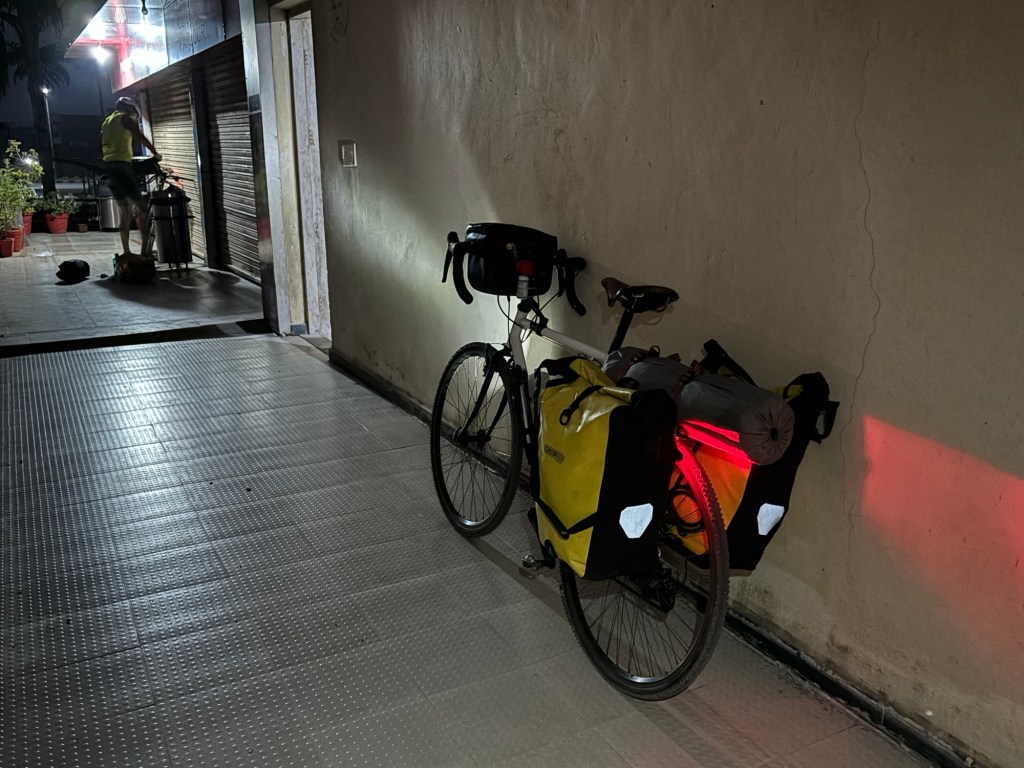
Morning is my favorite time of day in India. You see the country waking slowly, streets and dirt courtyards being swept, the animal dung from the night before being collected, citizens standing in the street brushing their teeth or squatting to empty their bowels, you see it all! Yet, somehow it feels natural and that you are witnessing a morning ritual as ancient as civilization itself. Riding in February and March as we did, there were often small fires burning for warmth with all manor of citizens huddled around. It looked very cinematographic and had they not been burning plastic with the leaves and other small twigs, I would have been tempted to join the assembled huddle myself. The light and sunrise are almost always spectacular, a consequence of the pollution and particulate suspended in the air.

Try to get the majority of the riding done before 1:00 PM since the afternoons can be quite brutal: the light is too strong, the traffic picks up, and the heat is invariably radiating upward off the road surface.
Prior to the tour, we were really at a loss to estimate our daily mileage for planning since we found almost no intel on mapping strategies, road surfaces, or routes. For context, a daily ride of 45-65 miles is standard for touring. More than that and you don’t feel you have time to stop and enjoy, rest under a perfect tree, or make unexpected conversation with someone interesting. And isn’t that the point of touring?
Even on the most challenging days of this tour, with camel tracks and up to 30 miles of sand and gravel, we found we could ride 50 miles without exhaustion. And over the five weeks, 50-60 miles was our average. After Matt returned to England, I had a week of higher mileage, 60-80 miles a day but that was in Madhya Pradesh, with long distances between villages and many fewer historical sights to draw away my attention. It was also a province that had virtually no small roads between villages, so I was riding the toll roads. These are OK, and not that busy in the mornings, but are a bit boring and always somewhat loud. With no one to talk to, I ended up resting less, and riding more.
Food: There is no breakfast in the countryside, no food until 10:30 if you’re really lucky, but more likely 12:30 PM. Even finding chai before 8:00 or 8:30 can be extremely rare. Knowing that in advance would have been very helpful. Our solution was to find bananas and oranges the afternoon prior (we could eat 6-7 bananas and 3-4 oranges each) and supplement with nuts. We created our own bag of “gorp” by buying nuts and seeds, of any description whenever we found them, and mixing them together. The Oxford English Dictionary defines gorp as a verb meaning “to eat greedily.” We found this to be the case. We named our version “nutcrack” and it sustained us most mornings. Almonds and sunflower seeds are relatively easy to find. Dates, sesame seeds mixed with jaggary, and sometimes even raw cashews are encountered more rarely but add considerable depth. The local chocolate is not worth eating and melts quickly, not worth the trouble. I don’t believe in the dense “bars” that many cyclists rely on. However, if I was planning to ride India again, I would make an exception and bring a big stash to sustain one during the morning famine. Luckily, I had a couple “Larabars,” (date-based bars from the US), and we enjoyed these immensely in our more desperate moments.
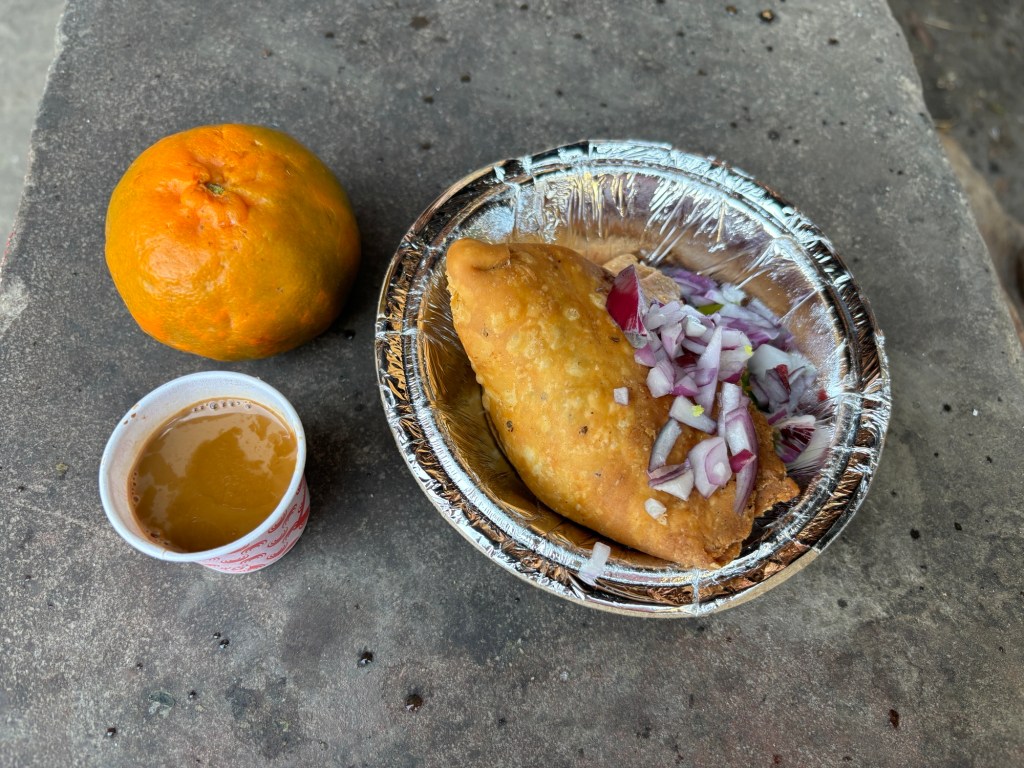
Samosas are triangular shaped pastry fried in light oil. They are typically stuffed with potato and some type of nutritious ground pulse. Dipped in a cilantro and chili “pesto” they are divine. I could eat three, sometimes four at a go. These typically cost 10 Rs. Each or about 12 cents US. How great is that? Perfect biking food.
Dinner isn’t generally available until 7:00 PM in India with most folks arriving about 8:00 PM. This is a bit on the late side for those riding 100 km a day. I’m typically ready to eat the table itself by then, especially if I’ve only been eating bananas, oranges, and “birdseed.”
Our dinner strategy evolved but we loved what we settled on. In larger towns or ones with significant temples or ruins that people come to see, it was standard to be handed a thick menu of absurd options, everything from Chow Mein to some approximation of “western cuisine.” In addition, the menu often offered twenty regional items from all over India. But before you get excited, look around. There is only a tiny kitchen with no refrigeration, staffed by a cook that has likely never been outside the province. What are the odds that the restaurant can cook any approximation of what is on offer? Zero. Our strategy was to use Google Translate to ask, “What is the local or regional specialty? What can we eat only in this area?” The relief on the server’s face was palpable! Not only that, but we ate what they had ingredients to make. It was a win, win.
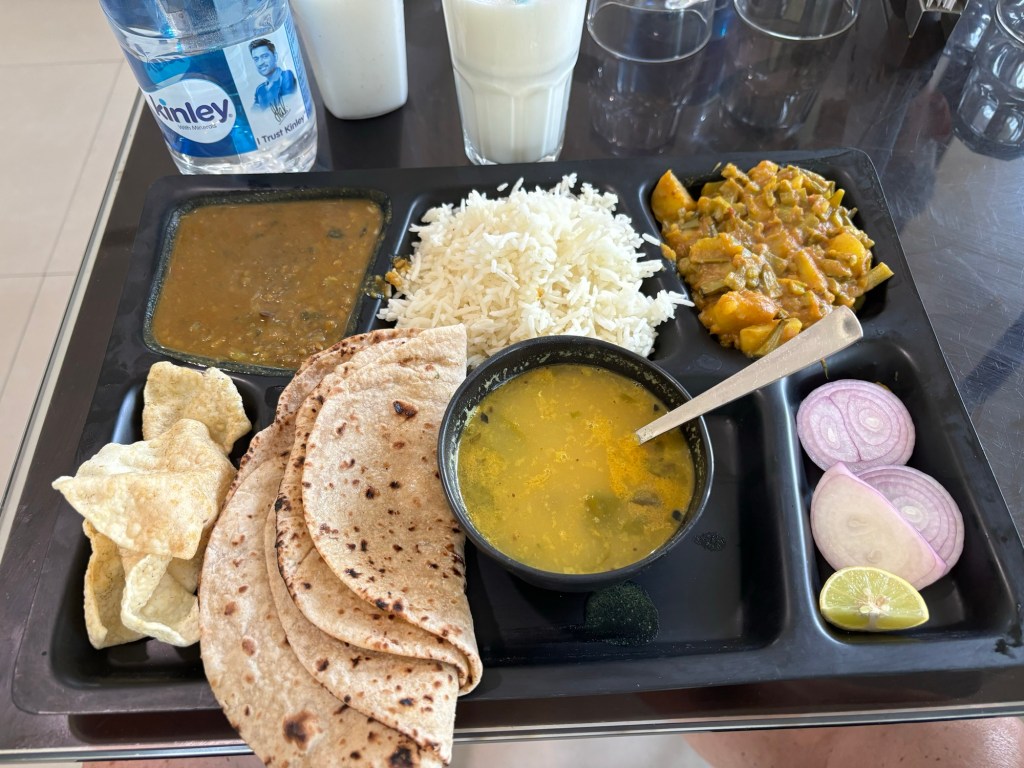
In an ideal world, you get two dishes (one vegetable curry and one dahl—fry dahl is particularly good) and a rice (many versions, all wonderful), plus whatever wheat or bread they make in that area. The naan was our favorite, but chapatis are far more common in the areas we rode. We always added ghee to the bread as we needed the calories. When traveling solo, I would sometimes only order a single dish and rice. The other option is to order the thali—a pre-set plate of two or three dishes, plus bread, rice and often a little sweet. This is essentially the Western Indian version of “this is what we made today and have available.” It also helps to shortcut the “google translate” negotiation. Thali is a specialty of Gujarat and sometimes available other provinces. The local buttermilk is also excellent and helps to temper the spice. Lassis are delicious but loaded with sugar. Everywhere I went, I tried to get them to make me a lassi without salt or sugar. I was never successful, not a single time. It’s simply not done.
Mapping: One of the thorniest questions we struggled to answer prior to the trip was how to actually navigate the route. I posted this question unsuccessfully on Reddit and even emailed India Hosts on Warm Showers (my wife and I host in Seattle). No intel was available. I got a range of answers but not one with direct experience.
Well, of this writing, I can say with authority that in the five provinces we traveled (Maharashtra, Gujarat, Rajasthan, Madhya Pradesh, Uttar Pradesh–1100 miles/ 1800 km), cell service was ubiquitous. Not all areas support cell data, so internet access was certainly intermittent, but we had no issue downloading maps when we had data or internet access. I used my ATT USA account and just paid the $10 a day / ten days max charge a month for international travel. Worked like a charm. Matt bought data for his UK phone and added additional data several times on the trip. I’m not certain the cost.
Google and Apple maps are a bit of a disaster in India. They only route you to the toll roads and highways. They don’t recognize the roads you actually want to ride. Worse, many of the hotels that were listed were “hallucinations” as they say in AI. There is nothing worse than riding across a packed city or town at the end of the day when you have ridden 100km and are hot and tired only to arrive at a “hotel” that doesn’t exist. This happened to us over and over. Finally, we figured out that these places of business are likely self-reporting. Not being particularly fluent in English, they just check all the boxes and get listed on Google. Have a little shed that makes Chai? Sure, check the hotel box…Eventually, we figured out that we had to see actual photos of beds under their listing. We wanted proof of life. No photos of beds? Not a hotel!
Back to mapping, the winner app in our experience was Komoot. The algorithm understood “bike touring” on the drop-down menu and routed us on the smallest roads and highways. Sometimes it would suggest taking the smallest alley off a main track. Incredulous, we would try it and sure enough, in 200 meters, it would turn into a road. That’s India. Other times it would suggest a turn and the road or alley wouldn’t exist. We would ride on and the app would either re-route, or insist we U-turn to look harder.
Matt had a GPS to which the Komoot app could export the route. When it worked, it was a dream since the turns are more easily anticipated. But the GPS signal was wildly inconsistent and seemed to only work less than half the time. After Matt flew home and I was riding solo, I used my Shokz headphones during the more technical stretches (like riding into Varanasi) and discovered it was much easier to follow the voice prompts than expect to be able to glance down at the stem-mounted phone in intense traffic and poor driving conditions.
Ultimately, you have to use a combination of Google and Komoot since there is no visual hierarchy for the cities or villages on Komoot; you can’t tell what is an intersection with a name vs. a town large enough to have a hotel or two. They all look the same. Toggling back and forth between the apps, we would use Google to locate our target town (one with at least one, hopefully two hotels) and then find that town on the Komoot map. This is harder than it sounds and realistically, must be done the night before. Once the target is identified, Komoot can find the best cycling route and send it to your GPS, although as I said, I’m not convinced the GPS was worth the bother.
Accommodation: Camping is generally not done in India due to scorpions, snakes, tigers, and other unfriendly animals. Also, hotels cost less than a camping spot in the Western US. If you need to camp in an emergency (and I would certainly carry gear for this unlikely scenario), choose a shrine or temple and try to be up off the ground. Most of these are gated, helpful to keep the cows and wild animals at bay, and several had plinths where one might sleep raised above the snakes and scorpions. My sense is that camping would be fine and, in some ways, easier to navigate than some of the truly terrible accommodation we encountered. But once in a groove, it is hard to switch back and forth. Human optimism also plays a part. “Surely the next hotel will be better than the last one.” Camping is also complicated by the food situation. There are no grocery stores whatsoever, so eating in a restaurant or stall is your only option. Unless you find a late lunch somewhere, you are going to go to bed hungry since riding out of the city or town in the dark after dinner is a non-starter. You definitely would need to find your camp before dark.
Unlike most countries, the hotels are on the highway, outside of town. Early in our learning we would ride into the center of town and then pull out our phones to see where we might stay. This invariably meant we had to retrace our steps to the highway that we had been avoiding all day. Once we figured this out, we would stop 10 miles out of town, choose the area with the most options, set it as the new target in Komoot or even Google (if we were close and would likely be required to ride the highway anyway), and set off. This final approach is all business and will be the worst part of your cycling day. The traffic and horns are almost unbearable, and people insist on trying to stop you to enquire what galaxy you might be from. All this while you’re riding and trying not to die! After a long and hot afternoon, it can be a bit much. We learned to save some “juice in the tank” for this invariable end-of-day shitshow.
Keep your expectations of the countryside hotel low, then cut them in half. We almost never had hot water or a shower that worked. Most had Western toilets without paper and some, not all, had water plumbed so they flushed (otherwise you use the shower bucket to flush it). Bedding was truly iffy. I mostly slept on top of my inflatable pad, wrapped in my summer sleeping bag (45 F degree bag), with my Turkish towel wrapping the pillow. I once awoke to admire a cockroach walking in circles on my bike saddle; the bike parked in my room next to the bed. When I got up and stuffed my bag, I found three more cockroaches in my bed. I was not thrilled. I read on the India blogs of travelers getting bed bugs. Luckily, this was not our experience, but I could certainly imagine it happening.
Occasionally, we would find a nicer hotel. Cost seemed to matter. Spend more if you have the option. It is still tiny money by comparison to almost anywhere else you can travel. But cost is not always consistent with better quality. It is really a crap shoot. We found the best accommodation through the Lonely Planet Guidebook. The book was invaluable for history, sites, guides, restaurants etc. although it only covered the larger tourist destinations. Still, it was a worthy investment.
Gear: We carried three types of water purification: iodine tablets (this takes four hours), bleach (couple of drops in a litter and you’re good in 30 minutes), and a Sawyer filter. Luckily, bottled water is now widely available, and we never used any of them. I will likely only carry the small bleach bottle in the future. It can be used as hand sanitizer and has other emergency uses. I brought a six-liter bladder for water storage if forced to camp. Never used it this trip. But I would likely bring it again for emergency camping.
My bike is outfitted with a larger water bottle cage that accepts a 1.4-liter Nalgene bottle. Unfortunately, I lost this prized sentimental possession on the flight over (it was covered in stickers from past tours!). The bottle somehow got kicked under my seat on the plane and I failed to collect it upon landing. Luckily, there is a disposable 2-liter water bottle widely available in India that fits in the same bracket, allowing me to carry almost three liters of water at a time. I routinely drank all this water by 2:00 PM. In my experience, you can be hungry when you ride, but never let yourself be thirsty.

Mounted under my water bottle cage is a block of plastic that cleverly hides an Apple AirTag. This was my first time using it and I enjoyed it. For example, I could tell my bike was transferred to my second flight while in the Amsterdam airport. On the train from Varanasi, I could see the bike missed my train. Later, I could tell it was on a later train and was able to track its progress across the country. Or, in a big city like Mumbai, head foggy with jet-lag, I could find my hotel by just looking at where the bike was located. I also sent the link to my wife and kids and told them to use the “find my Dad” function on their phones. It provided them a fun way to follow along from a distance. For $25, it was great entertainment for all and ultimately gave me some piece of mind. If the bike was stolen, I would at least know where it was headed. Since there are so few iPhones in India, the AirTag didn’t update as regularly as one would like. Still, it worked well enough. I would use it again for peace of mind.
We both carried mats for sleeping. Mine is a classic, full-body inflatable (1.5”). Matt carried a long yoga mat. Both were used extensively. Indian beds can be as simple as a pallet with a dirty sheet on it and a blanket of unknown provenance. I wrapped my pillow in my Turkish biking towel and used my lightweight (45 F degree) summer sleeping bag. I also carried an emergency bivouac sack in case we had to camp. We came close to camping, but never did. It was great peace of mind to have these things.
I brought a small cutting board, knife, and spork but never used any of them and will leave them home next trip to India. There are no grocery stores, so the normal biking lunch is not remotely possible. We carried no cooking gear whatsoever. I normally carry a Jetboil stove which gives lots of options but there was no need this trip.
Ortlieb panniers have become the standard worldwide and I can’t recommend them highly enough. Mine took the worst bouncing imaginable and never came unclipped. I normally ride with both front and back panniers but since we were not camping or cooking, I decided to leave the front panniers at home. This was a mistake. Being able to spread the load more evenly really helps, and even if only lightly filled, gives you better organization on a long tour.
I strap a 1.4 oz. airhorn to my stem. It blasts 120 decibels and is perfect for animals on the roadway, or poor drivers… You have to disconnect the screw-on horn from the canister when you fly, but having it in your checked bag seems to be no issue. I’ve done it for years.

I carried a thin climbing rope for clothes drying, Woolite soap, and clothes pins, which can help to separate your wet gear and make sure they dry by morning. We used this a lot. If arriving at a major UNESCO site and planning to stay two nights in the same hotel, it is possible to have the hotel do your laundry. Make sure to tell them you need it back the same day or it will come middle of the following day and delay you. The clothes came back beautifully clean, folded nicely, and cost hardly anything for the service.
I ride in a Hi Vis neon vest and insisted that Matt do the same. Day two, he thanked me for that tip since once on the road, the feeling of vulnerability is palpable. It might be my age, but I am decades past insisting that “my blacks match” and dressing the color of asphalt. If that’s the cost of looking “cool” while you ride, I’m out. I’m trying to stay alive and ride the world for another two decades. I like the hi vis Pearl iZUMi brand riding jacket since the sleeves zip off and make a vest. I started every day with the sleeves on for warmth (it was particularly cold in the mountains of Rajasthan in the morning) and stripped them off by 9:00 or 10:00 AM.
I also insist on blinky lights, front and back, for touring and I never turn them off at lunch or on breaks. Even in bright sun, these can be seen when you ride into shadow and the driver’s eyes have yet to adjust. I have typically only ever used blinky lights powered by AAA batteries; traveling with a small handful of fresh ones. Even going all day on the blinking setting, the batteries last 3-5 days. When camping, battery power works best since there is never enough access to electrical power to charge everything, especially if traveling with kids or in small groups. Even though I carry a solar charger and battery bank (this was never used in India and will be left home next trip), it does not supply enough power to manage USB lights on a predictable basis. Matt showed up with USB lights and invariably forgot to charge them several days in a row. Obviously, this never happens with batteries. However, once he got into the rhythm, his USB lights were brighter than mine, and I could see their special genius. If you can count on hotels and access to power, these USB lights definitely have their place.
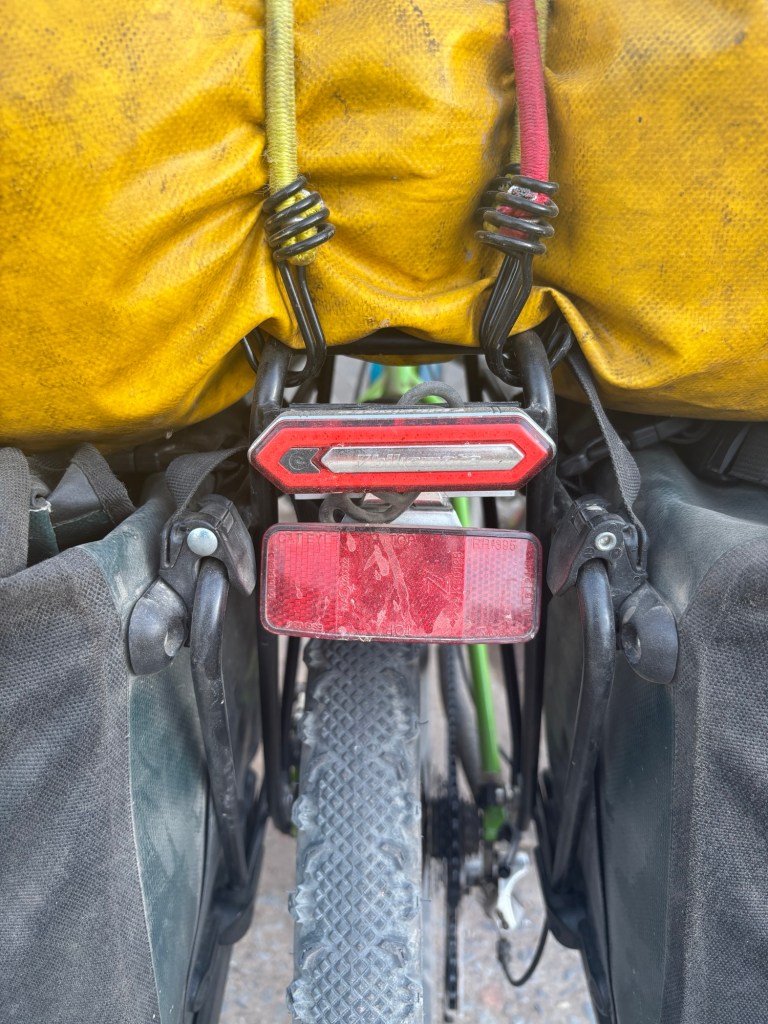
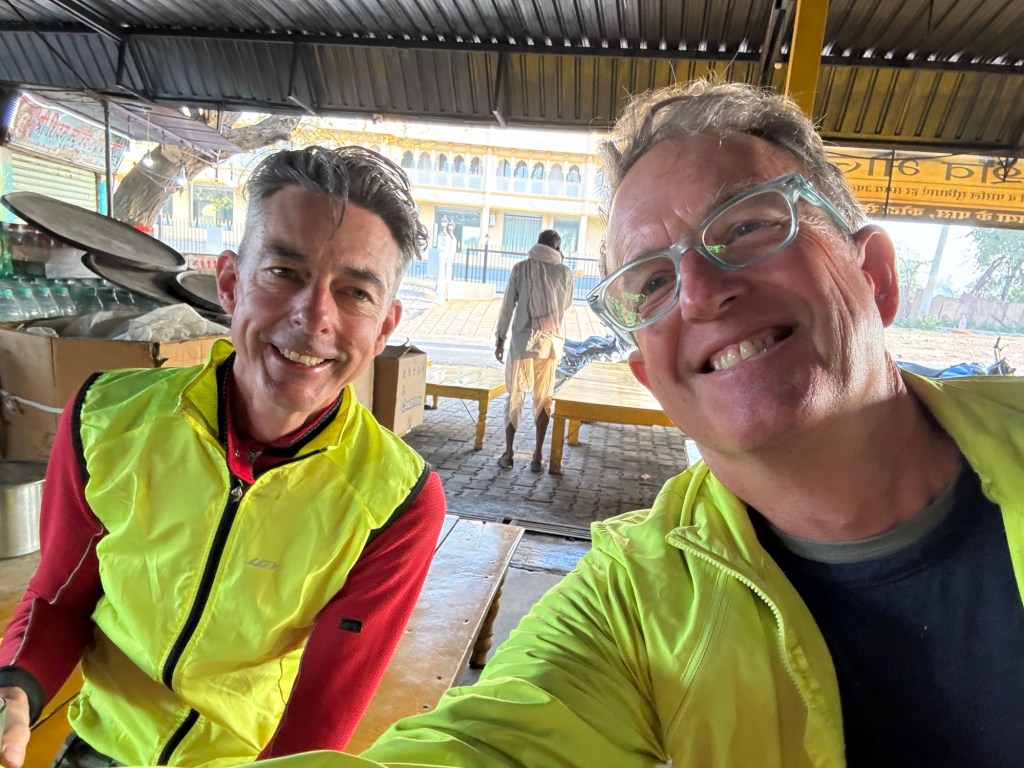
In recent years, I have switched to high-quality foam tape on my handlebars. But in the higher temperatures of India (riding mostly in 80-96 degrees (26-36C)), this tape stretches and moves. I will go back to my old-school method of using foam tape as the base, but then wrapping it well in the cloth tape of yore. Hard to improve on some things.
One last shoutout to the Ortlieb handlebar bag. I use the largest size. My kids call it the
“Dad bucket” since, like the “Mom Purse,” I have been known to pull out all kinds of unexpected miracles on demand. Single use eye drops? Got them. Sunglasses, hand sanitizer, tire irons and patches, phone cables, nail clippers, sunscreen, “nut crack” or gorp, compass, hand lotion, extra TP, Band-Aids, hex wrench set, money and phone, emergency photocopies of passport and medivac insurance, it’s all there. The Ortlieb is 100% waterproof (I’ve ridden with it through a monsoon in Hawaii) and unclips with a shoulder strap in a snap. I wrap a thin, 6’ kryptonite cable around the handlebar mount so it’s always handy and easy to use (I lock every time, regardless…).
Tools: Both Matt and I brought a full contingent of tools including an extra tube, tire, and even a 10” section of ten-speed chain and additional chain clips. We also carried a chain link tool since chains can be very difficult to repair and rejoin now that the machine tolerances are so thin. We carried dry lube (which we used frequently), grease, stainless nuts and bolts, tire irons and hex keys or Allen wrenches, spoke wrench, Brooks saddle wrench (which we both used), spare spokes, and patch kits (bring fresh glue!). We both used the tubes (for speed of repair, patching at night) but nothing else. Still, although this took a fair amount of space and we used almost none of it, I would bring every single item again. There is NOTHING available on the road.
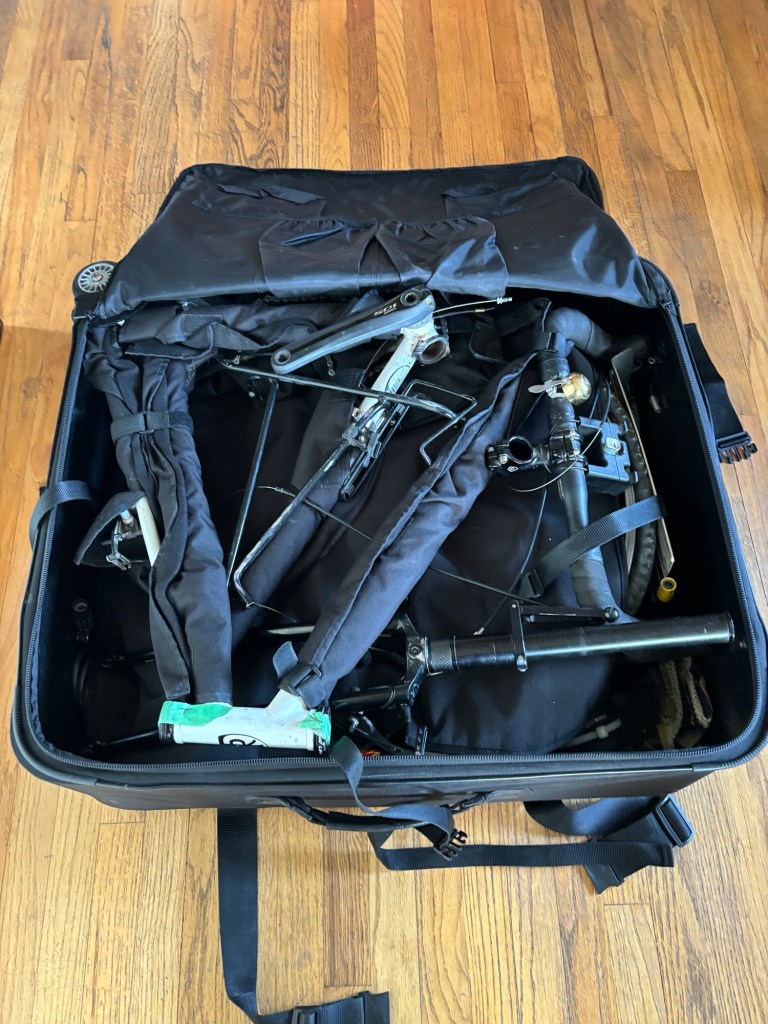
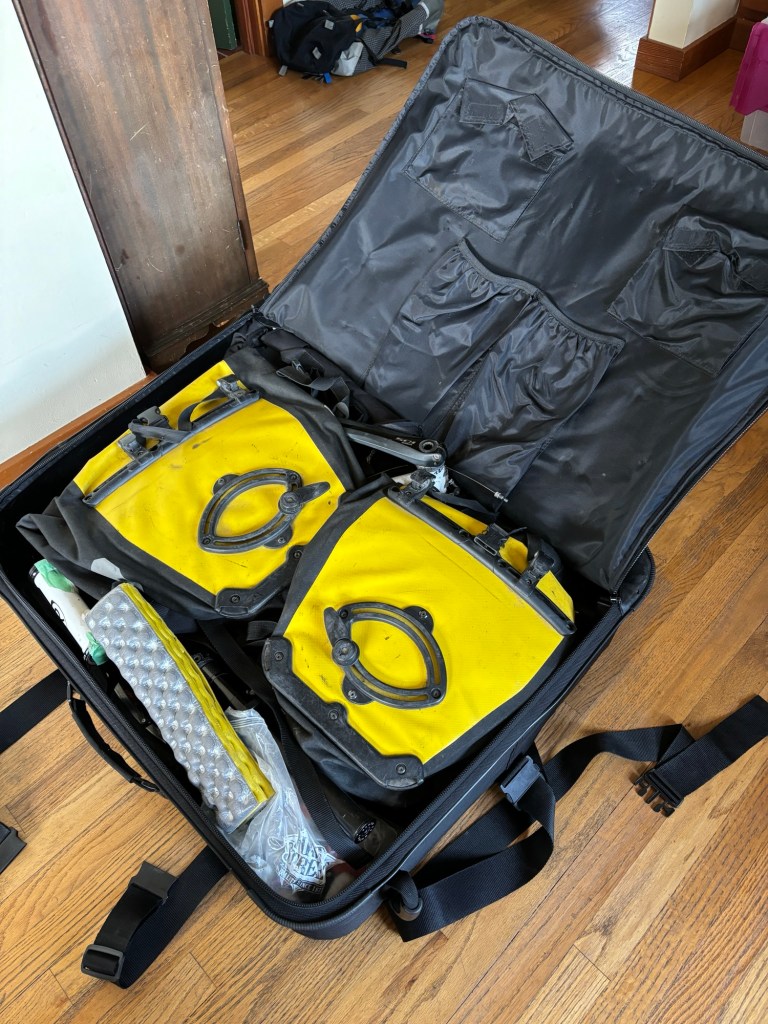
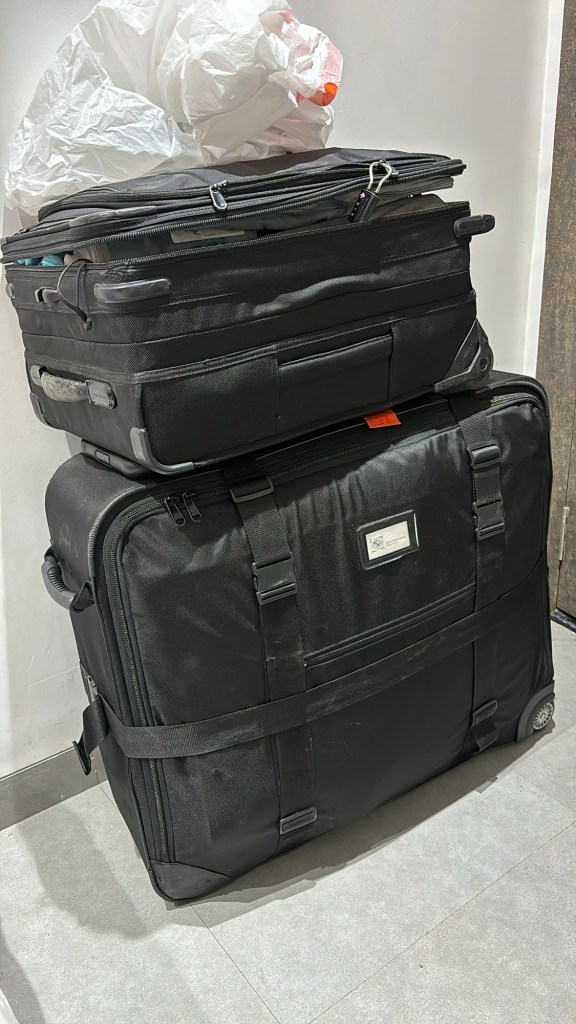
Bike Types: I ride a Ritchey Breakaway, a cross bike that completely comes apart and goes into a suitcase, checking as regular luggage. I also cut my rear rack in half so that it flat packs in my bike bag. Carrying a rear rack in your carry-on bag is difficult although I have been forced to do it in the past. My cut and bolted rear rack worked perfectly.
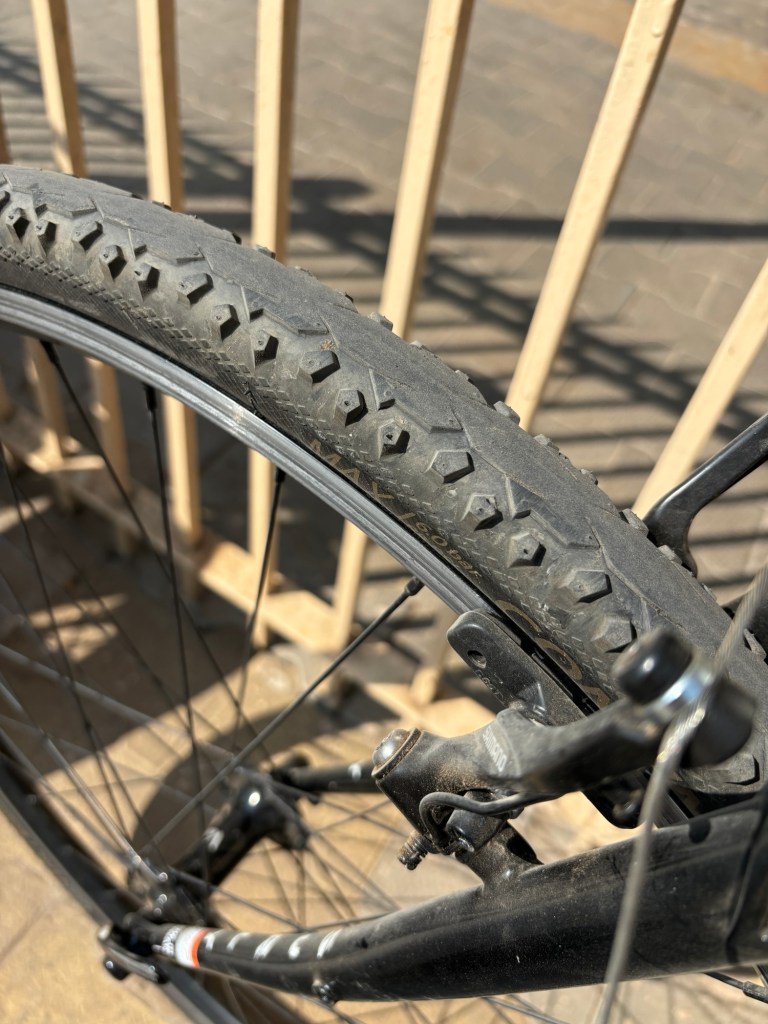
I run 37mm cross tires and like how they roll on pavement, giving you a bit extra on the shoulder of the tire for gravel. However, my tires were way too small for the amount of off-road riding we were forced to do. Unfortunately, that is the max width tire my frame can accommodate. In other countries I’ve ridden, this has never been an issue. But India presents a much wider range of road surfaces, even within a one-mile stretch. You can find yourself riding perfect asphalt in one moment, then without warning, crashing through cratered mud track the next, followed by chip seal with loose gravel. This makes flying down the grades impossible since you can’t count on the road surface enough to let loose on the brakes. There are also inexplicable speed bumps or “road humps” as Matt called them, that come out of nowhere. I hit several quite hard and was sure my panniers would come flying off the bike. It never happened (go Ortlieb!). I made my 37mm tires work, but it took great concentration to “pick my line” whereas Matt was able to point his bike in the general direction and fly on through.
Matt rode a mountain bike called a Cotic Soul 26 with 2.2” tires (56mm on 26” wheels) and fared much better. He said he would consider even wider tires next time. He also had hydraulic front forks which he loved, although the cable length limitation kept his handlebars too low, and he fought his riding position for a month with sore shoulders that bordered on chronic pain.
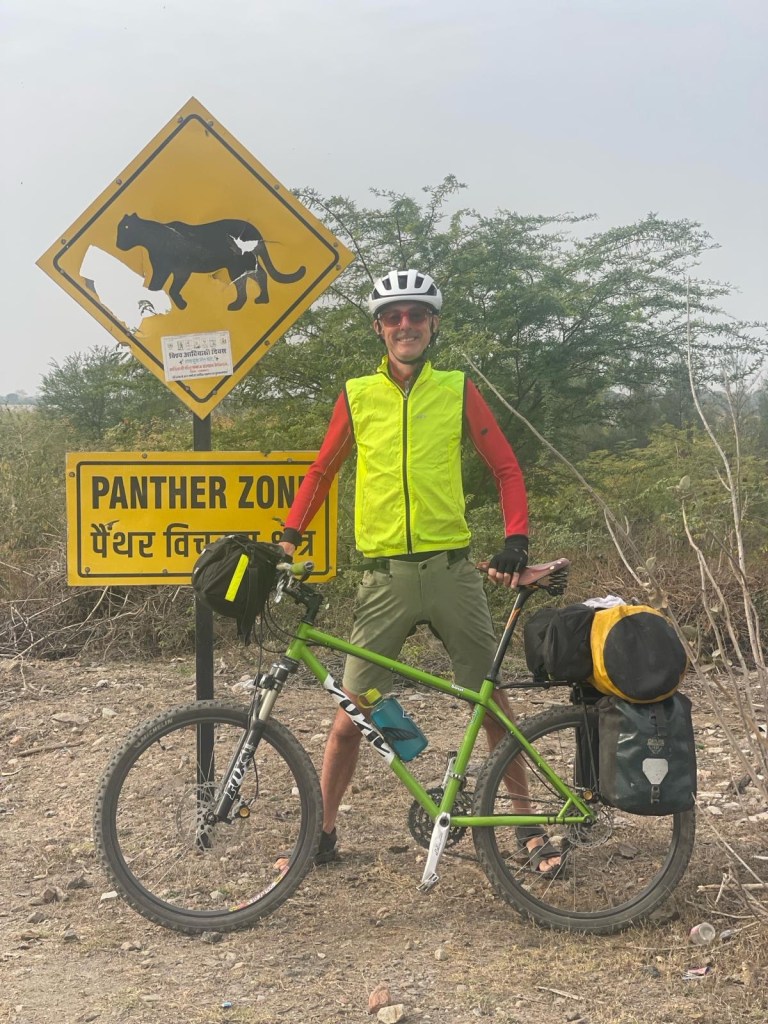
There is no perfect bike for touring. My bike flew on the good road surface (80%?) but was significantly slower on the sections “off-piste.” However, due to the wide range of road conditions, I would have to say that for India, the mountain bike style with wider tires is likely a better choice than my cross bike. I wouldn’t buy another bike if you don’t own one (I don’t), but if you are choosing between two good options, choose the one with the widest tires you own.
A note about wheels: I built my touring wheels by taking a class in Seattle at Bikeworks, a local non-profit. It was great fun and I got exactly what I wanted. For the Ritchey, I made sure to build the strongest and most standard 700c wheels I could. By that, I mean choosing spokes that are most likely to be found around the world and of the most standard shape (not bladed). I used sealed hubs from Velo Orange (mid-range), and built four-cross, forty-spoke wheels (crossing the spokes four times). This is what I run on my touring tandems and they are the strongest wheels you can make. One change I would consider is to add a charging front hub to power the phone, mapping, and now, extra bright USB blinky lights.
Advance Prep: I bought emergency medical evacuation insurance for my trip and my riding partner Matt did the same. I used this site: www.squaremouth.com. If they aren’t covering your entire trip (flights etc.) the cost is de minimis.
The other critical thing to organize is your first aid kit. Yes, true, you can get anything at a pharmacy in India, even strong drugs of all kinds. But I don’t know the names of all these things and can’t be counted on to get it right. Also, when you are sick, the thought of going out to navigate the city to find what one might need is an overwhelming task. I strongly recommend you bring it with you and be prepared in advance. In my case, this required a trip or call to my internist/ doctor who, learning of my big adventure, got busy writing script, no further questions asked. This is what I carried:
First Aid kit:
• Benadryl
• Advil and Tylenol (in a pinch, you can take both on a three-hour rotation)
• Neosporin
• Baking soda for wasp stings
• 4” gauze with tape, large band aids
• Imodium
Pain:
• Hydrocodone 15/ 500mg. (sub for Vicodin)
Antibiotics
• Azithromycin 6/500mg. take with Imodium for traveler’s diarrhea
Fungal infections
• Triamcinolone ointment .1% for rashes, steroid– skin infections or rashes (jungle rot)
• Lotrimin: anti-fungal for feat or groin
In closing, two entries pasted from my other blog posts. The first is from my entry Safety Third. It considers what I call the Hierarchy of Indian Vehicular Evil.
The second entry is from a post titled Making the Gods Laugh and contains an excellent medical questionnaire a friend sent when my riding partner Matt became violently ill and I was forced to find him a hospital. The idea is that when you are working in translation, you need to have a perfect understanding of what you are trying to convey. The questionnaire allowed me to elicit the information in advance and answer the questions for Matt with authority. This proved so invaluable that I intend to add it to my best practices list. Going forward, I will keep it as part of my printed handlebar bag documents.
Hierarchy of Indian Vehicular Evil.
Riding solo the last few days has brought the challenges and joys of bike touring into sharp relief. The experience of exploring alone is remarkably different from tackling a challenge together. Most notably I found my first flashes of real anger as my life was repeatedly put in mortal danger. Both events resulted from a type of pincer movement to force me to a stop to procure a selfie. The first time it happened, a group of teenage boys, three to a motorbike, seemed friendly enough until they cut me off and came to a stop in front of me. I was forced to break so hard I almost went over the handlebars. Unleashing a string of invective Tom Stoppard would have marveled at, the boys quickly retreated and scooted away. Assuming this was a one-off, I shook it off and soldiered on. An hour later, it happened again, this time with a large sedan, forcing me to a stop on a steep highway overpass in a crush of oncoming traffic. “Selfie? Where are you from?” Let’s just say he didn’t get the answer he was expecting. Variations of this event happened two more times that day alone. This never happened while riding with Matt. If my rights and safety can be so easily violated as a sixty-three year old man, I can only Imagine what it must be like to travel as a single woman in this country…
These encounters led me to contemplate what I’ll call the Hierarchy of Indian Vehicular Evil:
◦ Teenage boys, three or four to a motorbike occupy the top spot for danger. Brimming with hormones in a culture where the opposite sex is held far out of range, they seem especially crazed. A friend who worked as a visiting nurse in the emergency hospitals of Vail and Telluride Colorado once shared the medical staff used a shorthand on the triage charts: YAMIS—young male invincibility syndrome. “This one jumped off a two-hundred-meter cliff with skis and no parachute.” You get the idea. Convinced at that age of our infallible reflexes and perfect judgment, it’s a wonder any of us males survived to carry on the species.
◦ Tuk tuks: the ultimate short-term thinkers, these drivers are like veteran prostitutes; it’s all about turning as many tricks in the shortest time possible. They will stop on a dime, turn right or left without signal or notice, cut through spaces designed for something half as large, and eject passengers from either side of the vehicle without notice. Hanging a u-turn and heading the wrong way in traffic is normal. Scrapping their carts against parked or moving objects, normal. Horn blaring full blast, normal.
◦ The New Rich: India has a status problem, the selfie phenomenon only a symptom. Everyone wants to be the Maharajah. Private car ownership is still rare in India and in the countryside we saw very few. Those we did encounter are driving huge SUV’s and invariably barreled straight at us with the same pathetic attitude I often find in rural America. “This is my road and you mean nothing.” This type of grotesque entitlement is familiar to those who bike tour. In the USA, it’s almost always the drivers of these absurdly large cars, or those towing a three bedroom house behind for “camping” in the local RV Park. Interestingly in India, the bright blinking lights give them some pause. So do hand gestures indicating “more space required.” I guess the rest of the population just goes off the road without a fight, a graphic demonstration of what I informally call “Gross Weight Rules.” But by holding one’s ground, perhaps gesturing appropriately, we gave them momentary pause, at least long enough to get by. I wish that worked in the US.
◦ Middle-Aged Male: Not unlike the US, these drivers are a crap shoot. Overweight and riding solo on their motorcycle with a backpack, they can be friendly or aggressive in equal measure. Some, will blow past—horn blowing—as if you have hindered them from an important meeting with Prime Minister Modi himself. Most are indifferent, as if these space aliens show up here all the time and I already bought the T-shirt. And many will slow to circle around you and get their courage up to ask you questions, almost never in English. This invariably leads to a selfie request. Not happening.
◦ Buses and Trucks: ironically, these are the least worry in India. Truckers especially, are in it for the “long haul.” They live the road and many offered us unfailing admiration and a thumbs up to boot. Although still daunting, they generally drive safe speeds and always left enough room when passing us. Their load-tying is an art in itself. I never saw a tarp flapping or rope dangling. Buses too are professional but live energetically on their horns and tear along at breakneck speeds. Still, they are pros.
◦ Family Motorcycles: I love these guys. Four or five souls on a motorbike, infant draped languidly over the lap of the mother in back, second infant held by an older child, Dad is saving petrol and moving the bike as predictably as possible. As a fellow traveler, I know exactly where he is going and we understand each other. Often driving barefoot, without gloves or eye protection, and of course without a helmet, these Dads are a marvel of care and efficiency. They are getting it done and it is likely everyone will live to tell the tale.
Mary Carlin is a dear friend and retired Public Health Nurse who spent several decades in the refuge camps of Africa. She send me this medical intake questionnaire so as to get the critical information in advance of the doctor or hospital visit. When working in translation or with medical professionals using broken or incomplete English, this form proved vital.
Health Questionnaire for the injured or sick in your care:
Here are some questions to ask, or symptoms to note that you can take to a local physician to see what your friend has.
(Ask him if he has any medical problems, and what medications he is taking.)
When did he first feel sick:
What was first symptoms:
Get a thermometer and take his temperature.
Is he vomiting? How often? Any blood or bile?
Nauseous?
Does he have diarrhea?
Blood? Mucous?
How many times a day?
Abdominal pain or urgency?
Gas?
Do stools float if you have a water-based toilet?
You mentioned he had a sore throat. Does he still?
Does he have any swollen lymph nodes on his neck or elsewhere?
Does he have any difficulty breathing?
Is he coughing? (Productive cough? Color of sputum, volume? Blood)
Shortness of breath?
Chest pain? What relieves it? What makes it worse?
(Note that for coughing and chest pain you definitely want to get diagnosed and treated to rule out a pneumonia. You are also in areas with terrible air quality that makes things worse.)
What is his mental status?
Is he sleeping?
Is he fatigued?
Does he have a rash?
Where? Is the rash flat, itchy, raised, bulbous, red? Does he have a rash on his hand and feet?
Does he have any petechial hemorrhages (blood blisters where they has been pressure?”
Did he have any insect bites? (Mosquito, tick, flea etc.)
Did he eat or drink anything that he thing might have been associated with the symptoms?
What vaccines did he take? (reduces risk on disease of those issues.)
What travel related medications is he taking if any?
How much has he been eating?
How much has he been drinking?
Does he have headaches?
(When did they start, how long did they last, what helped, if anything)
Does he have new joint pain?
(Which joints, swelling, tenderness). Describe the pain.
Does he have positional hypotension? (When he is lying flat in bed, then sits up does he feel dizzy? Can indicate dehydration or problems related to a variety of diseases.)


 Bike Touring India
Leave a reply to Mike Rhodes Cancel reply