Squaring the Circle

It might be skimming the edge of the hyperbolic to say that one of architecture’s great struggles has been to dome—read circle—the square space it rests on. Istanbul’s Hagia Sophia and Brunelleschi’s dome for the cathedral in Florence are not just milestones in the development of the form, they stand as breakthrough achievements that changed the course of architecture itself.

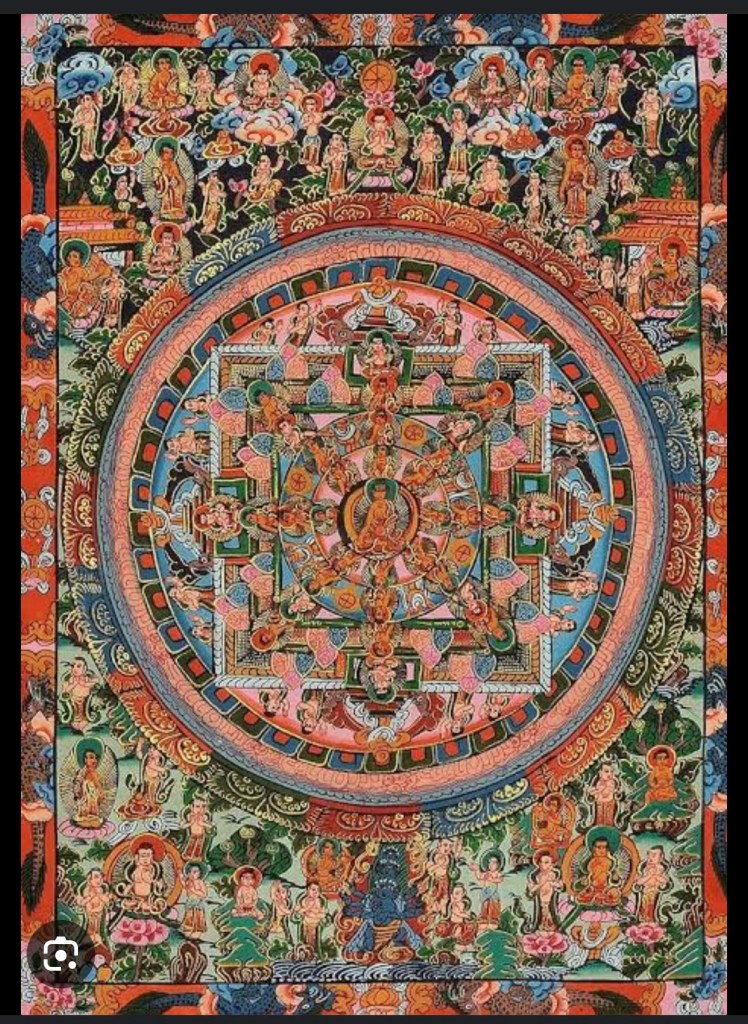
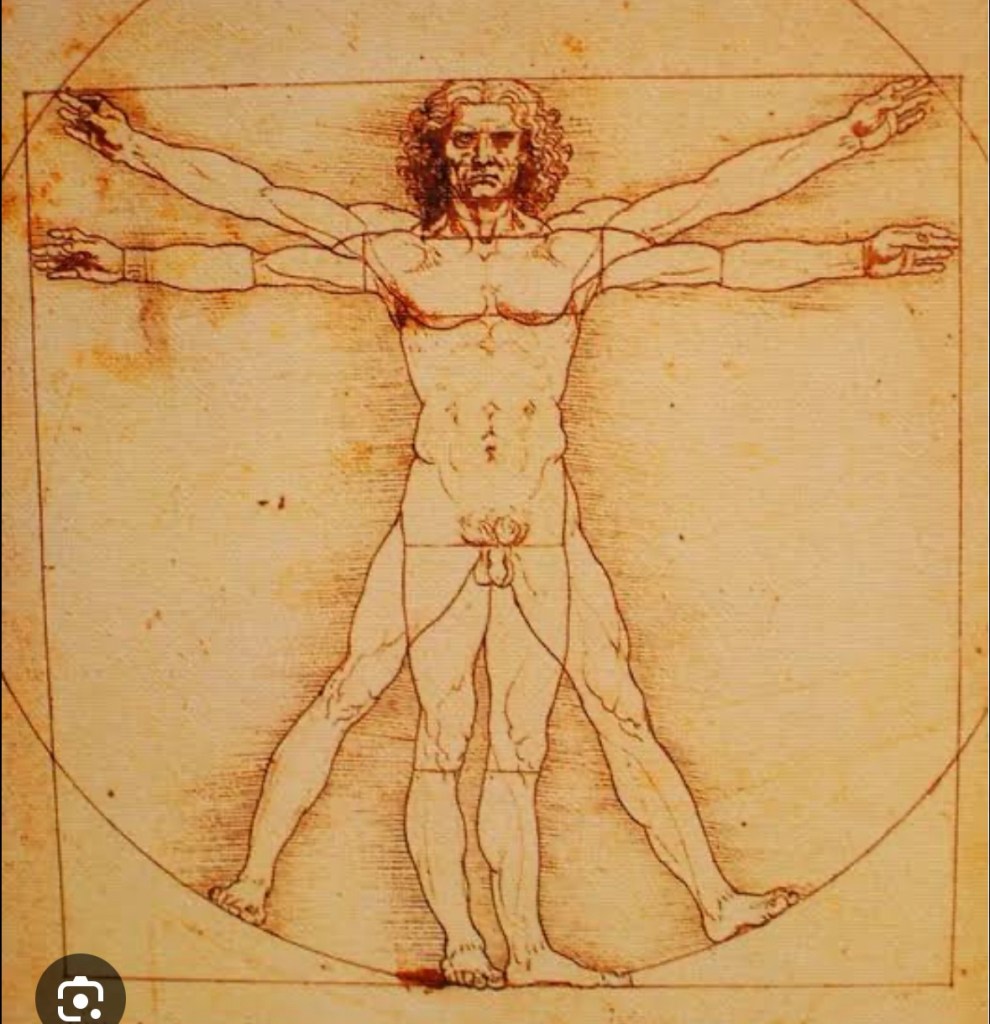
Of course, this effort to resolve circle within the square also offers a profound metaphor for the transformation of the human soul. Many Buddhist mandalas sit within the square frame of ego consciousness, and even Da Vinci’s Vitruvian Man diagramed man’s extremities within the circle and square, hinting at the divine symmetry implicit in the human form. Within the medieval guild in Siena where I formally trained, squaring the circle was primary to the Sacred Geometries and central to the closely held secrets.
Interestingly, I dreamt this visual symbol this week and upon awaking, decided I would explore the concept in a blog posting. Not one hour later, out of the blue, Matt used exact phrase in a discussion of sculpture; how when the form finds harmony, one has, in fact, “squared the circle.” I love such synchronicities and, as I’m fond of saying, “If you think it’s all a big coincidence, then you’re not paying attention.”

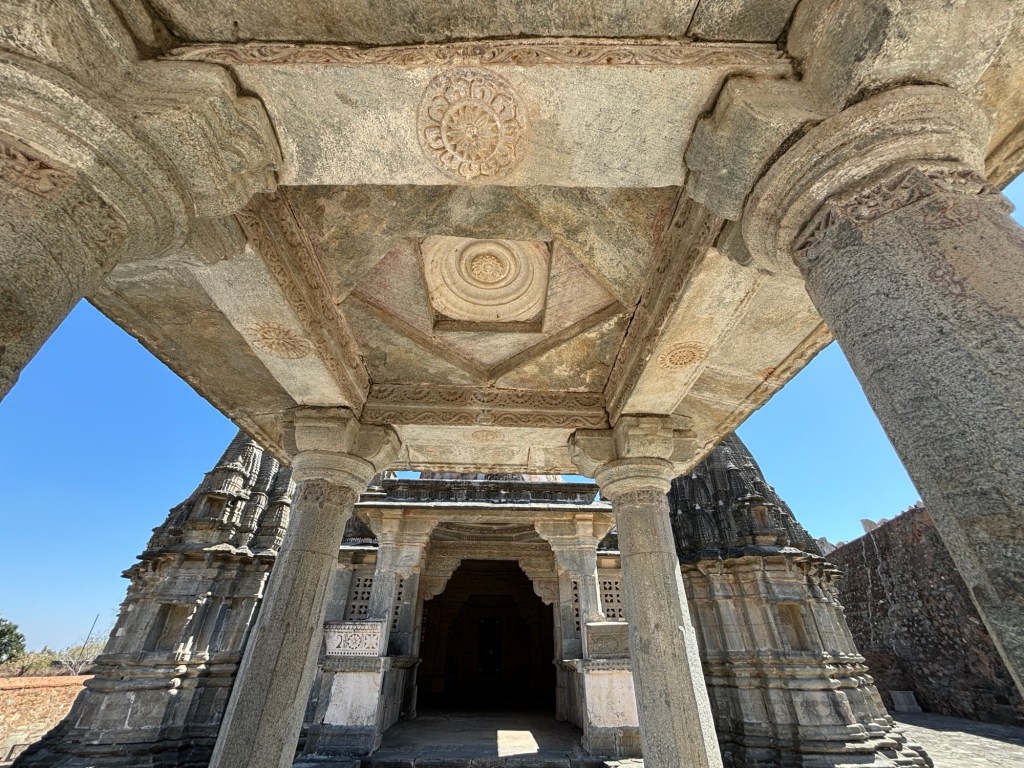
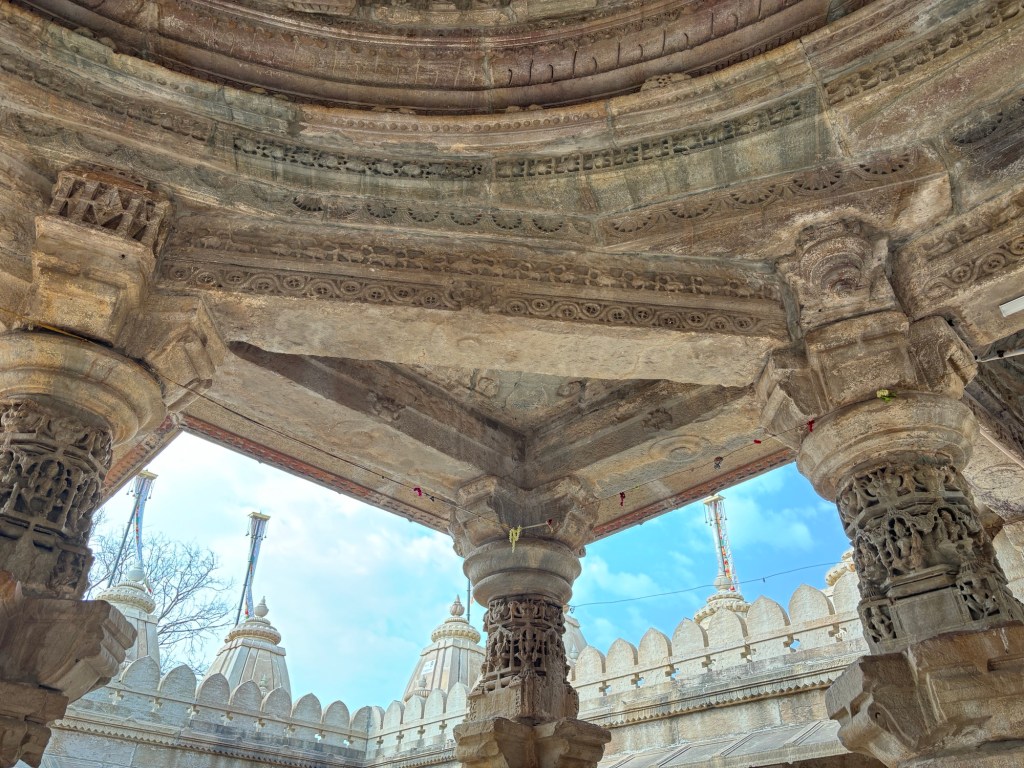
At the hill fort at Kumbahlgarh, we find clear examples of several successful squaring the circle strategies. For smaller domes, an overlay of large triangular stones cantilevering from each 90 degree corner is a common solution. A second course then extends and bridges those stones on the forty-five and the void is almost closed. A third course, a single large stone, caps and closes the void. The backside of these stones (away from the void they cover) would be pitched off to shed water. Finally, several coats of render (a plaster coat used structurally for waterproofing) would be applied. Sometimes this is wrapped with exterior courses of wrought stone. This method works for very small scale domes, say 6-7’ (or less) in diameter and often forms the hallway roofing we have seen repeatedly in early Jain Temples. In the best examples, these simple dome assemblies are elaborately carved on the underside, some with breathtaking complexity. Unfortunately, Jain temples that are actively in use (like Dewali at Mt. Abu), do not allow photography; images are typically available online.

This example is from Kumbhalgarh.
This slightly larger version shows three layers before the capstone. Also from Kumbhalgarh.
Example from Kumbhalgarh.

For the larger openings, the squaring of the circle becomes much more technical and tenuous. In most western architecture, a funny cantilevered shoulder called a “squinch,” is placed in each of the square’s corners as a way of cheating the dome’s support inward. This is done to offer purchase to the dome (circle) that must be supported over the (square) volume below.
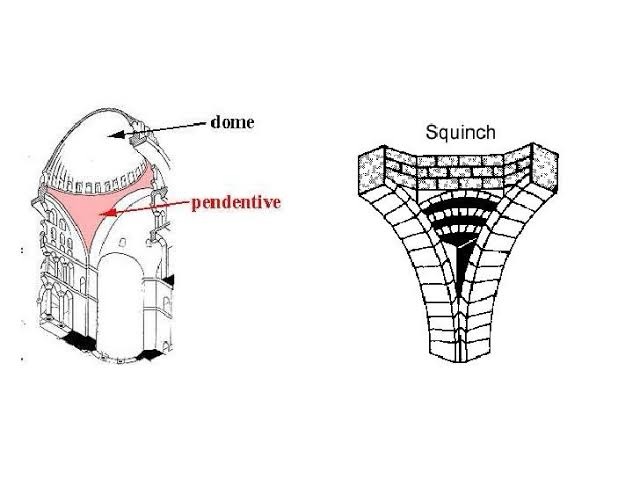
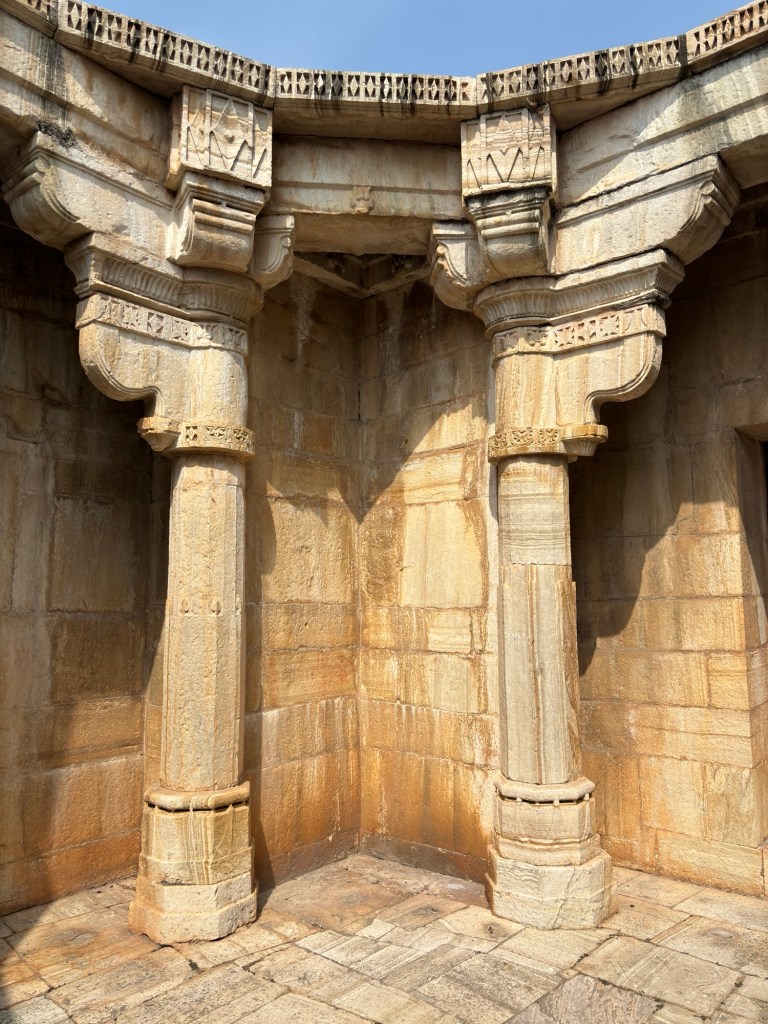
In India, a different approach has been developed. This method uses a five-sided capital to support an extra lintel that spans the square volume’s corners. Although this works well, the forward leg of the capital that supports this lintel (the capital leg pointing toward the center of the space) does not extend orthogonally as one might expect. Rather this forward leg heads out at 60 degrees to give maximum support to the dome (circle) above. Confused? My drawing below should help.

Chittorgarh
Chittorgarh
Chittorgarh

To my eye, although this method obviously works well and has stood the test of time, the 60 degree angle looks off. It doesn’t project forward in the way one expects and therefore sits uncomfortably. Thinking back to my early guild training in Italy, This may be one of those textbook examples my teacher and master mason of the guild—Maestro Fabrini—would cite. He would often try to explain that even if something is technically perfect, “if it looks wrong, we have failed.” This concept, known as “make it sweet to the eye,” opens the path to a host of visual sleights of hand at the center of craft mastery—in both sculpture and architecture. It is what makes the Parthenon in Athens such a compelling building. As I’m sure you may remember, there are multiple sleights of hand that bend the lines of the Parthenon to make sure the result sings and remains sweet to the eye. In sculpture, it’s the elongated neck, or lengthened leg. Having it accurately reflect the form is secondary. It is far more important to feel right.

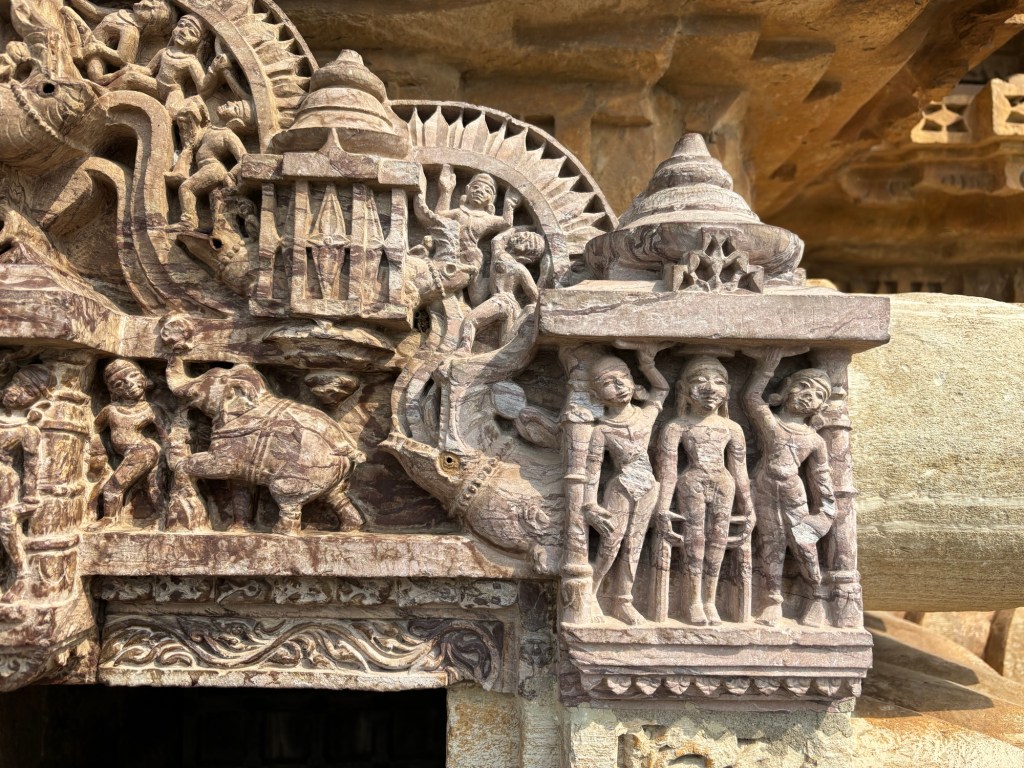
Chittorgarh
Chittorgarh
Chittorgarh
Chittorgarh

13 responses to “Squaring the Circle”

  1. While cycle touring one expects some deviance from just a ” I am riding my bike and having an upset tummy ” narrative, but these discussions exceed all the normal expectations. I am glad you are feeling better and hope the good karma continues for quite a while.
    take care
    alex

    Liked by 1 person

    1. Wonderful, Alex! Just trying to keep you guessing 😝

      Like

  2. You are clearly not in Kansas. Or any place governed by Western proportions or orders. Those column capitals are wild! Should we assume that there was a dome once, where now there is open sky?

    And that stone – it has very exotic stripes, and a lovely color.

    Liked by 1 person

    1. Yes, exactly. The dome has failed and is now gone. But that helps us see the structure underneath. So interesting, right?

      Like

  3. jchien1d9ff808d9 Avatar
    jchien1d9ff808d9

    To a scientist who is largely ignorant of the technical history behind such beauties, your deetours down these educational path are just absolutely delightful and makes my day. Thank you Richard!!

    Liked by 1 person

    1. That makes my day! Thanks for posting.

      Like

  4. Stephen Smith Avatar
    Stephen Smith

    Your narrative brings back memories of a month we spent in India 30 years ago! It felt like entering a magical, musical universe I didn’t know existed. Like you, Carla and I were sick and in the hospital within a week of arriving but recovered and continued an amazing journey.

    Your blog is like a personally guided tour of Indian architecture and sculpture. So much to understand and appreciate! Thank you and Matt for this epic photo narrative of your journey.

    Steve

    Liked by 1 person

    1. Wonderful message, Steve! I’m so pleased to learn that it is resonating with your memories. India has changed far less in those thirty years than I expected. The ox and camel carts are mostly gone but at least in the countryside where we are riding, life continues as it has for thousands of years. 🙏

      Like

  5. I’m a bit of a nerd about the history of math, and I can tell you that the term originated with the ancient Greeks who through techniques of ruler and compass were able to do amazing things, such as: draw a square with exactly the same area as a given triangle (or pentagon!). Naturally, when straight line geometry was conquered, they turned to curves, and the obvious problem was: draw a square with the same area as a given circle, which is the origin of the term.

    The problem was not solved in antiquity, nor in the Middle Ages, nor in the Renaissance, or the Enlightenment, though a great deal of pseudo-mathematics was promoted in claims that it had been done. The common understanding of “squaring the circle” comes from the perceived, and real, difficulty of this problem.

    Finally, in the 19th century, when we understood the strange zoo of numbers hiding in plain sight on a number line was it proved to be impossible.

    The proof follows from the discovery that pi is a so-called transcendental number, which is defined to be a number that isn’t an integer, nor a fraction of two integers, nor the square root, or cube root, or n-th root of any other number.

    What’s left? How do we know anything is left? Strangely, almost all numbers are transcendental, meaning that if you were to throw a dart at an idealized number line, the place where it landed would be a transcendental number with probability 100%! Real numbers are wonderfully weird.

    Thank you for following me on that detour. Now back to architecture observed from atop two circles.

    Like

  6. Richard, I am not well versed in the technicalities but I know beauty when I see it!
    More, please!

    Liked by 1 person

    1. So pleased you’re following along. Best, R

      Like

  7. So, the common corbel is a step on the way to this? I love your appreciation of details, without derailing into countercultural fawning. That’s also transcendental!

    Also, I think Santa Fe is on the way back from India…

    Liked by 1 person

    1. Yes, the corbel is the basic mechanism of trying to bridge one side to the other. But it can only reach so far and works best when resolved into a circle which locks each ring together in compression. Having said that, there are occasional examples of corbel only strategies. I saw my first yesterday and it has stood since the first century. Still, I wouldn’t stand under it in a high wind or earthquake! Will try to do a post that includes some photos of that since it was so unusual.
      Best to you! R

      Like

Leave a reply to Stephen Smith Cancel reply