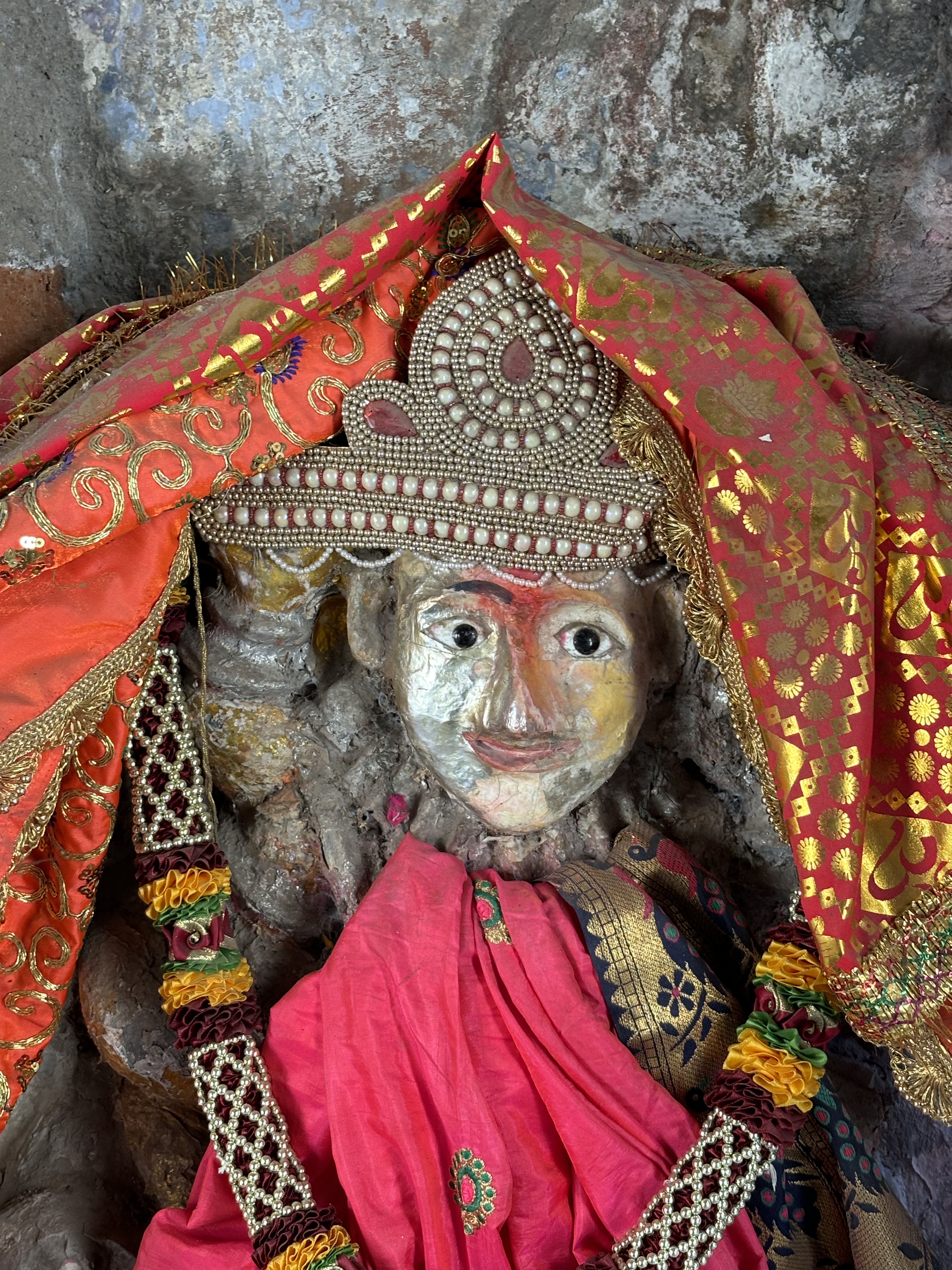
It is well known, if only vaguely understood, that the gods are still present in India. The veil is thin here in some inexplicable way. Many people feel it. I notice it most strongly at the most primitive pagan shrines (can we still use that word?) that seem to pop up at every turn. In these holy places, the embellishments are frugal: some orange paint, a drape of tin foil or faded fabric, a worn stone Ingham, and of course, a modest bowl of oil, its wick smoking and lapping at the shaded darkness.

There is often no formal sculpture, rather a bulge of natural stone made into a face or a simple root ball—now painted orange—that was found to be touched with the sacred. Offerings are always present: a coconut, a handful of rice grains, an orchid or marigold. Sometimes there is even a coin, or a 10 rupee note. But the feeling in these places! It calls to an ancient part of oneself where expressing gratitude, asking for guidance, or simply sitting with the great mystery as it rises up and faces us in our solitude, can be fully experienced.

Yesterday, I found myself kneeling at one of these simple, godlike forms and felt moved to ask for guidance. In the profound silence of the little cave, I offered up my heartfelt prayer. Imagine my surprise when I thought I heard snickering. I ducked outside to confirm I was alone. There was no one else.
In English, of course, we say “to make God laugh, tell her your plans.” With an estimated 300 million gods in the Hindu pantheon alone, the chortling at the misadventure Matt and I are having is an audible roar. Even I heard it.
Letting Matt recover a third night in Mt Abu seemed prudent. That second day we succeeded in walking the couple miles to the Dawari temple and enjoyed several hours of sketching, neither of us in obvious distress. We also enjoyed a nice dinner out, settled our hotel bill and headed early to bed for our planned 6:00 AM departure the next morning. Our plan seemed solid.
Ha!
Matt’s illness kicked into hyperdrive during the night, soaking his sheets with sweat. With chills and an obvious fever, we were definitely not descending the 1000 meter grade on our bikes. There was little to be done except let him try to rest and sleep.
I headed out on my bike unburdened by panniers, a special joy on a loaded tour. After days of hauling one’s forty pound kit, an unloaded bike soars through the landscape light as the down from a cottonwood. Euphoric, I raced through the hilly mountaintop roads looking for architecture to sketch, spending the hours of this unexpected day like drunken sailer on shore leave.
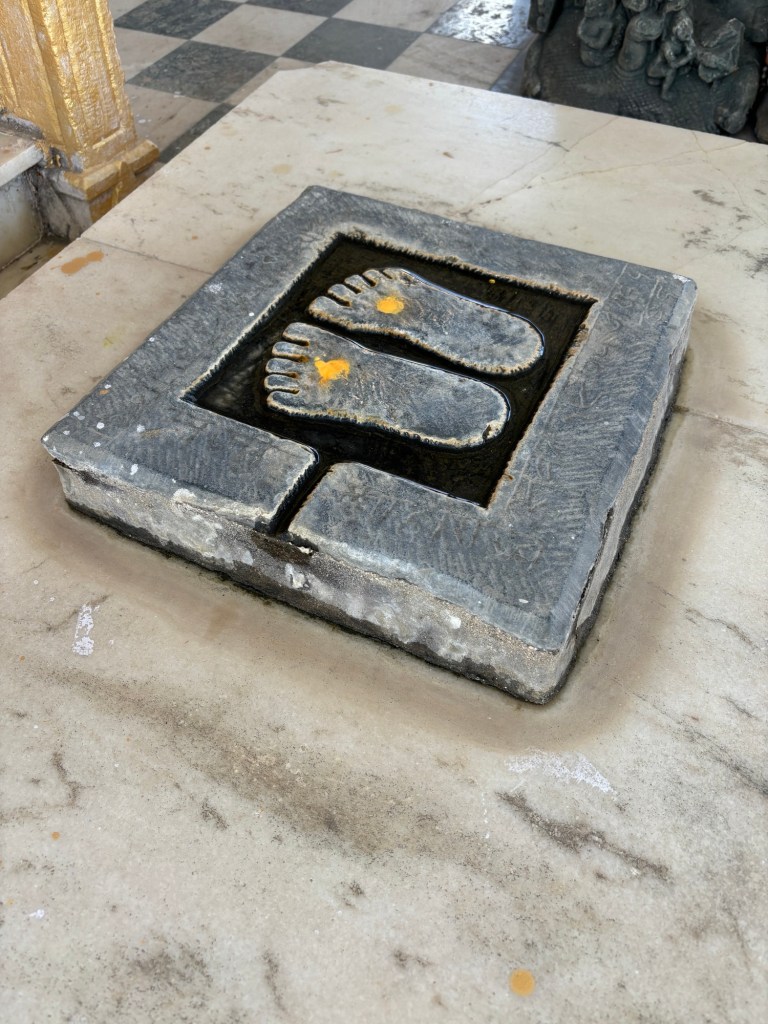
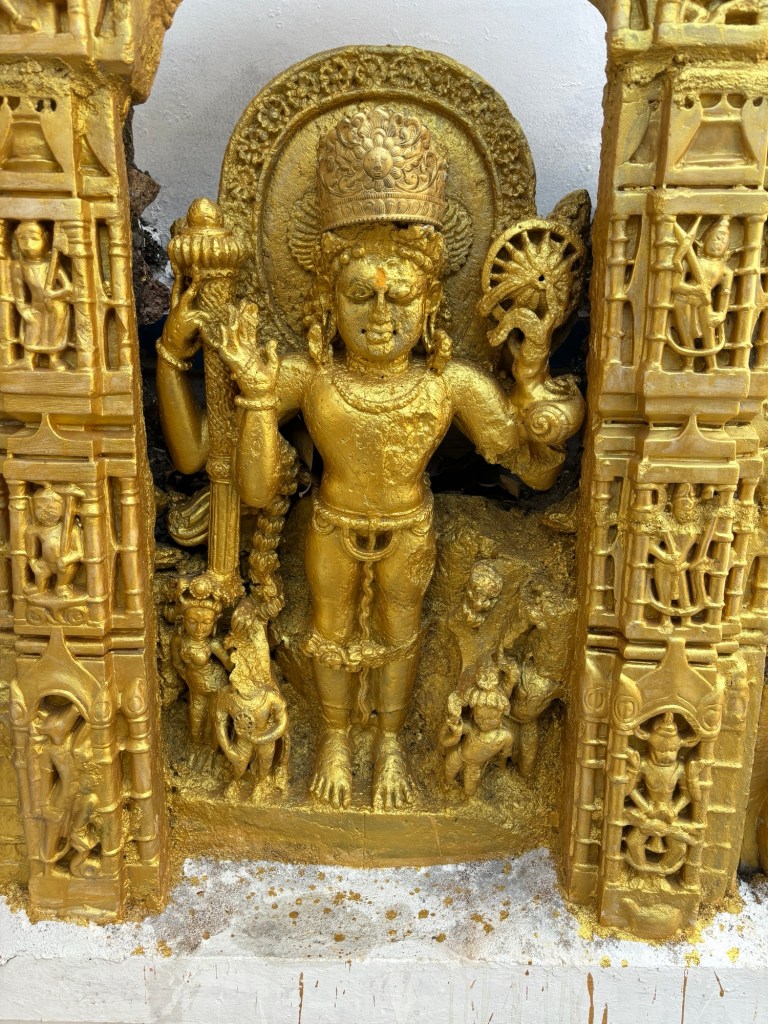
Eventually, I found a sign for an Ashram built improbably into the side of a cliff. The narrow, roughly paved track to the summit turned steep with a 15% grade the last mile. With the bike unloaded, I rode the whole way to the top and felt strong. I locked my bike and descended the 725 uneven steps to the small temple. The place has a deep history. Many hundreds of years ago someone important meditated here and that lineage is traced all the way to the current sadu. I apologize for not being able to track who this original enlightened soul was, or his relationship to Hinduism, but there were no signs I could read. Anyway, the current teacher was lecturing to a group of 20 well-dressed young professionals who had descended the same steep stair and were now sitting at his his feet. I was impressed. While the sadu shared his sermon, I quietly explored and photographed the temple carvings, eventually settling down to sketch. I was served tea and invited to take food with the wiseman, but with my stomach unhappy, I declined the food.
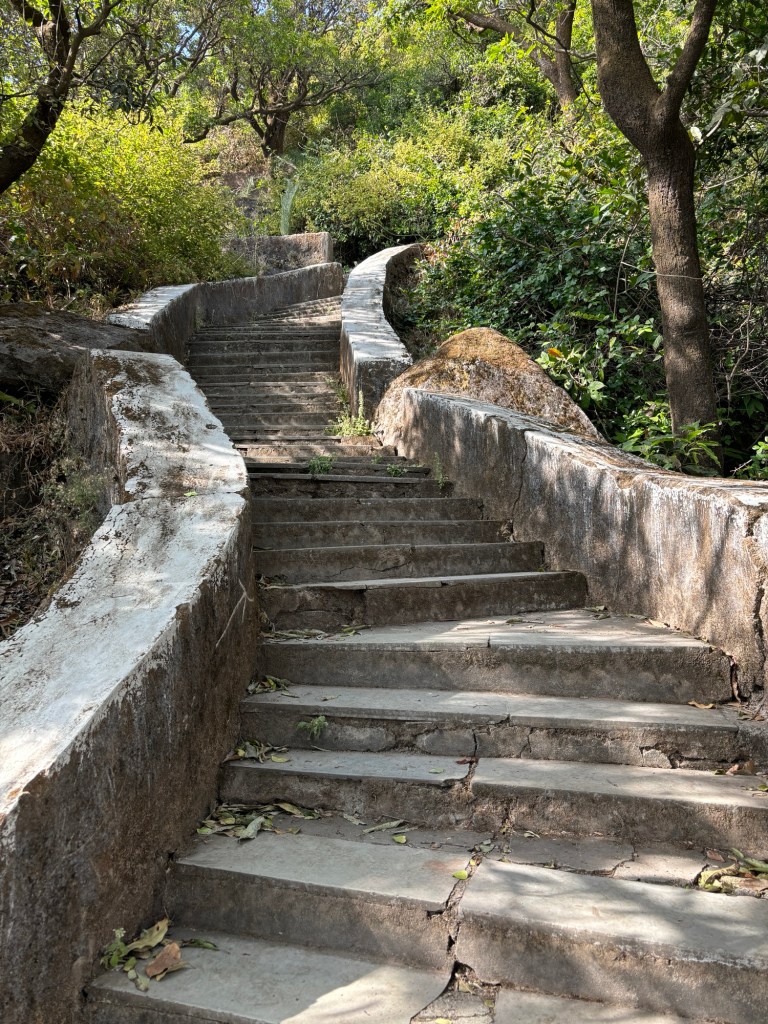

As an outsider who doesn’t speak the language, my conclusions are suspect. But I couldn’t square the image of this very thin “wise-man” having the filthy, five-year-old girl sweep the entire courtyard while he held court; or the two six-year-old boys who were carrying massive bundles of fresh cut grass on their heads, wind down the 725 tread staircase to feed the few cows that roamed the temple courtyard. The boys’ small legs were shorter than some of the stair risers. Maybe this was the Sadu’s act of service and these child workers were paid some nominal amount? I certainly hope so. Regardless, I found it upsetting.
Travelers must walk a balance beam of hardness and vulnerability to reap the deeper benefits of what they find. If you steel your heart too strongly, you feel nothing of the place you visit. If you don’t fortify that your heart enough, India in particular will break you in short order. Like many things in life, the balance is elusive and always shifting.
Each of us has our own unique emotional Achilles heal. For Matt, the thousands of street dogs and puppies, their bloated carcasses littering the roads we ride, affect him deeply. Me, not so much. But seeing feral children, filthy and likely diseased, breaks me in half. And there is something about little girls with matted hair that I find unspeakably heartbreaking. I spent hours—decades really—cleaning, brushing, and braiding the hair of my five daughters and they relished it. It was a critical part of my “laying on of hands” parenting strategy to build their self-esteem and self-care. Although simplistic, I want the sadu to wash that child as part of his spiritual journey. That seems so basic.

In the background of this day, Danielle and a dear friend, Mary Catlin—a retired public health nurse with decades experience in African refugee camps—kicked into high gear to understand Matt’s worsening condition. They urged me to call a doctor and Mary sent an incredible medical intake questionnaire that I could use to convey information once we found one. This form proved so valuable that I will carry it with me on future trips as part of my best practices print-out. I thought I knew Matt’s symptoms but only with the help of the questionnaire did I discover he suffered a mosquito bite last Weds. at the water tank of Ravi Ni Vav! The unexplained full body pain started to look a lot like dengue—bone break fever.
I will attach Mary’s questionnaire to the end of this posting.
Alas, by 9:00 PM, the doctor had still not shown up despite repeated conversations. I made the hard call and took Matt to the hospital. He was feverish, chilled, and sweating, in physical pain (7-8 on a ten point scale), and mentally confused.

The hospital drew blood, gave him an IV with pain meds and sedatives, and asked us to return in the morning when his labs would be completed. They offered to keep him overnight but agreed the hotel might be more comfortable. The IV meds proved a godsend as Matt slept for the first time in several nights.
Returning the next day, we learned the blood work ruled out our wild imaginings. It wasn’t dengue or malaria, but a major bacterial infection. With a big dose of antibiotics, he started to improve almost immediately. By this morning, Matt had picked up his journal for the first time in six days. Serious progress.


Alas, my stomach troubles have reached the breaking point and I just started my own antibiotics. I haven’t really eaten in 48 hours, have become weak, chilled, and am afraid to leave the hotel toilet. And so it goes.
One amusing anecdote I’ll share (although decidedly TMI—too much information), was my effort to collect my stool sample to drop off at the hospital lab later today. I was given a small plastic cup. However, let’s just say there is no good way to do this when your bowels are emptying at 100 mph…
Ah, the glamour of international travel.
Mary Carlin’s medical intake questionnaire:
Here are some questions to ask, or symptoms to note that you can take to a local physician to see what your friend has.
(Ask him if he has any medical problems, and what medications he is taking.)
When did he first feel sick:
What was first symptoms:
Get a thermometer and take his temperature.
Is he vomiting? How often? Any blood or bile?
Nauseous?
Does he have diarrhea?
Blood? Mucous?
How many times a day?
Abdominal pain or urgency?
Gas?
Do stools float if you have a water-based toilet?
You mentioned he had a sore throat. Does he still?
Does he have any swollen lymph nodes on his neck or elsewhere?
Does he have any difficulty breathing?
Is he coughing? (Productive cough? Color of sputum, volume? Blood)
Shortness of breath?
Chest pain? What relieves it? What makes it worse?
(Note that for coughing and chest pain you definitely want to get diagnosed and treated to rule out a pneumonia. You are also in areas with terrible air quality that makes things worse.)
What is his mental status?
Is he sleeping?
Is he fatigued?
Does he have a rash?
Where? Is the rash flat, itchy, raised, bulbous, red? Does he have a rash on his hand and feet?
Does he have any petechial hemorrhages (blood blisters where they has been pressure?”
Did he have any insect bites? (Mosquito, tick, flea etc.)
Did he eat or drink anything that he thing might have been associated with the symptoms?
What vaccines did he take? (reduces risk on disease of those issues.)
What travel related medications is he taking if any?
How much has he been eating?
How much has he been drinking?
Does he have headaches?
(When did they start, how long did they last, what helped, if anything)
Does he have new joint pain?
(Which joints, swelling, tenderness). Describe the pain.
Does he have positional hypotension? (When he is lying flat in bed, then sits up does he feel dizzy? Can indicate dehydration or problems related to a variety of diseases.)


 Bike Touring India
Leave a reply to David Gedye Cancel reply