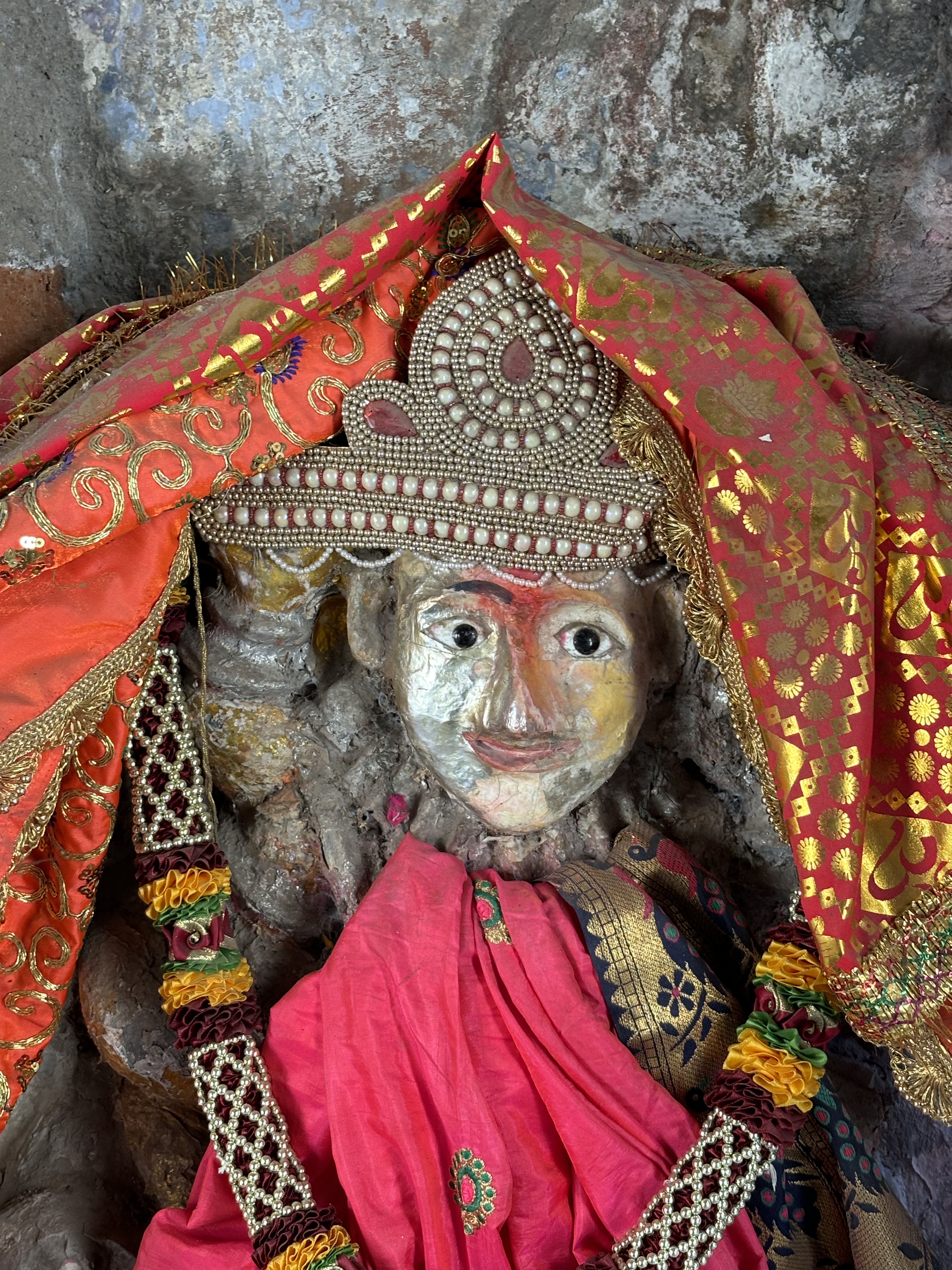
The Basti (small townsite) of Shravanabelgola is considered the most ancient and prominent sacred place of the Jains in South India. It has also been referred to as “Dakshina-Kāśī,” or “Benaras (Varanasi) of the South.” The seat of several significant temples, it is also home to the world’s largest monolithic sculpture completed in 980 CE. Located in the south-eastern part of the state of Karnataka, it sits about 160K west of Bangalore. It turns out that the prefix “Śravana,” attached to the name of a place (in this case, “Belagola”), is derived from the Sanskrit meaning Jain ascetic. It is reported that many Jain ascetics would practice penance for long periods here, typically ending their lives will a willing submission to death as prescribed in the Jain scriptures.
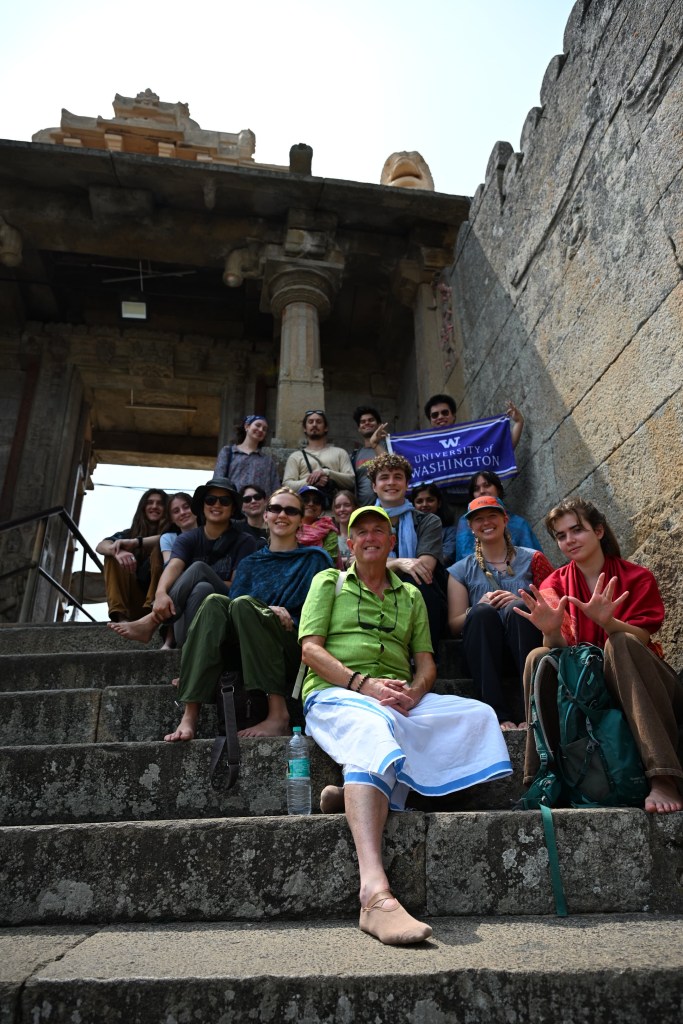
As part of my visiting Burges Professorship for the University of Washington’s Department of Civil and Environmental Engineering program, I thought it important that the UW students, spending their winter semester in Bangalore, get a chance to experience this important cultural site. As it turns out, this important monument is only vaguely known and lightly visited by those outside the Jain religion, Indian Nationals and Westerners alike.
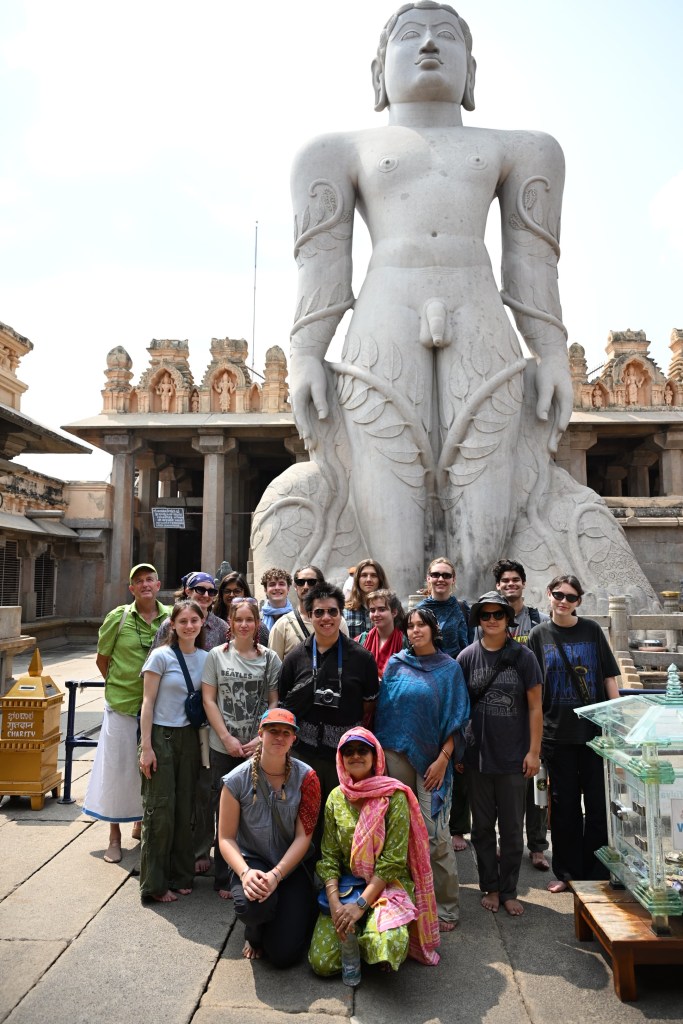
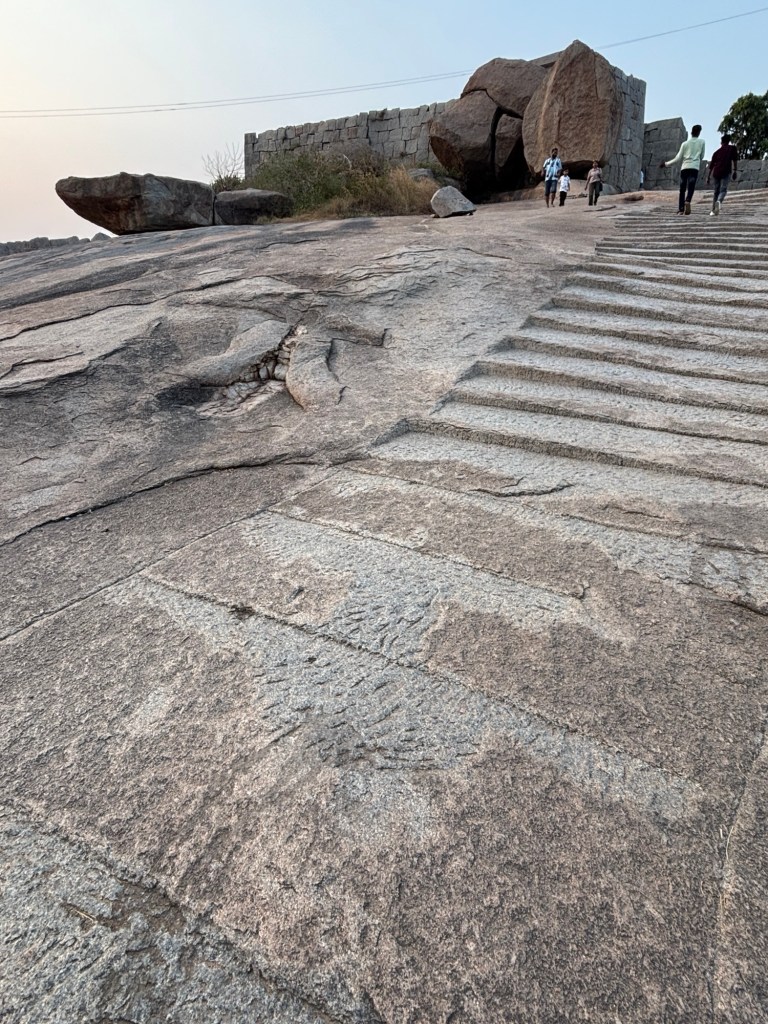
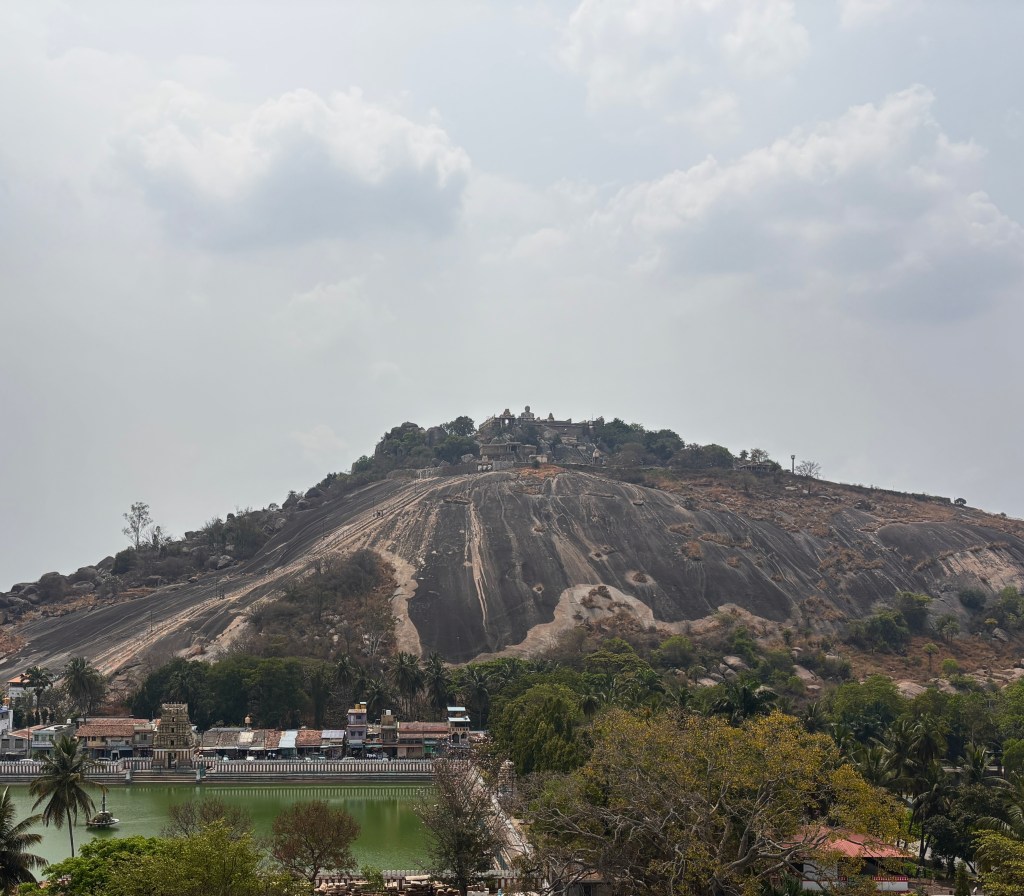
Leaving at 5:30 AM with the students, we missed the traffic, stopped for breakfast, and were climbing the steep granite hill where most of the temples are located by 9:30. The large hill is known as Vindhyagiri and reaches a height of 3,347 ft, rising 470’ from the small town and tank below. It is reached by climbing more than 700 steps carved into the granite bedrock. Since this is an active Basti or Jain pilgrimage site, shoes must be checked at the base of the hill. Socks may be worn to protect the feet from burning on the hot stone as it heats up during the day. When we arrived, the steep stairs were already significantly warm. As many of you will have experienced, granite, with its constituent quartz crystal, captures the light. Light being heat, this heat remains trapped in the stone and can burn the feet as the intense light of South India is captured throughout the day. Incidentally, granite is not the only stone to demonstrate this attribute; sandstones and schists also share this fate. In fact, broadly speaking, almost all stones except limestones and slates (no crystal), suffer this attribute. Even man-made stones like concrete pavers will heat up dangerously in sunlight (the crystal is from the sand which might be silica or quartz).
But before we address the famous monolith at the top of largest hill known as Vindhyagiri, let’s start our journey of discovery on the second hill, located on the other side of the large tank and village (only 300 meters away), since it is here that the most important historical events marking the site first unfolded.
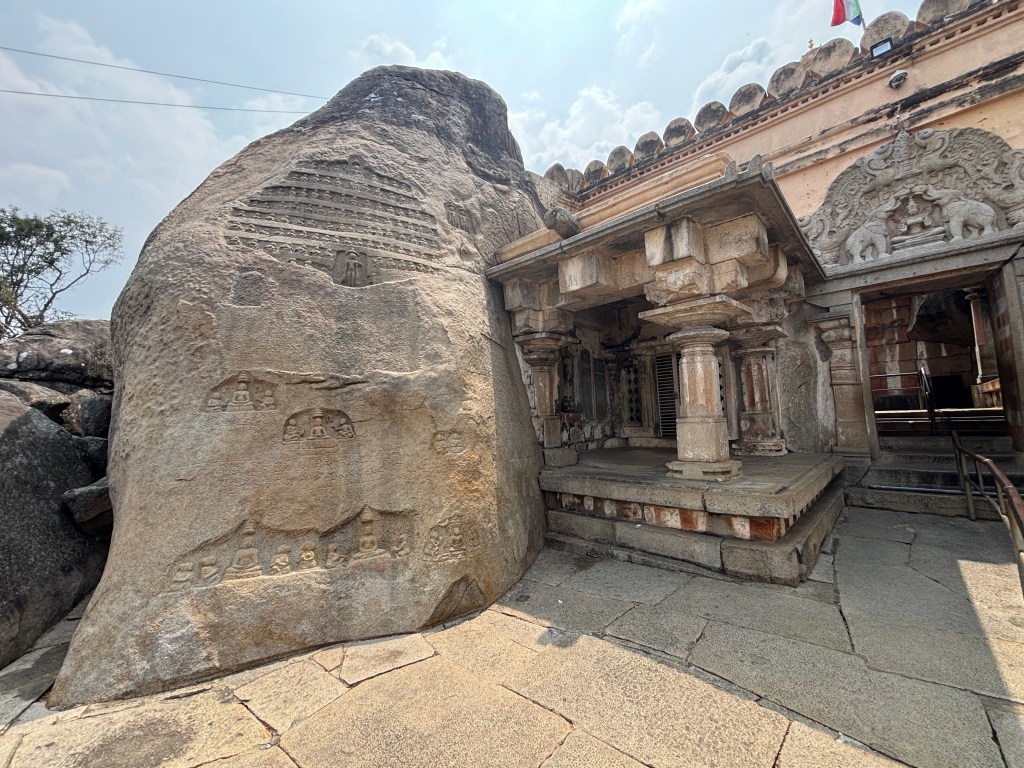
The second small hill across from Shravanabelgola is called Ancient Kalavappu. It’s only 3,052’ tall, rising 295’ from the village below. Again, shoes must be checked and the worn stone stairs, carved into the living rock, ascended. There are 13 temples on this smaller hilltop, all are in the Dravidian Style of architecture; the earliest dating from the 8th century.
One of the key elements making the area central to the interests of historians are the inscriptions carved in stone. These number an astonishing 576, the highest number in the entire state of Karnataka and that includes the sprawling kingdom of Vijayanagara, or what we have come to call Hampi. The most significant inscription is likely the inscription from Chavundaraya who was the Commander-in-Chief of Ganga, King of Rachamalla. Chavundaraya was in service to the King, called Chandragupta Maurya, who became the first emperor of India and founder of the Mauryan Dynasty.
Emperor Chandragupta famously relinquished his crown after a series of 16 dreams prophesied a great famine in his kingdom that would last for 12 years. Discussing these dreams at length with his spiritual advisor and teacher, Bhadrabāhu (who sounds a lot like a talented Jungian analyst with a great lineage), he was so moved, that he turned over his Kingdom to his eldest son and decamped his kingdom in Bihar, North India with 12,000 Jain ascetics to the small hill across from Shravanabelgola. This is the smaller hill known as Ancient KalavappuIt. The inscriptions tell us that he hoped to preserve the Jian religion in its “pristine purity” from the protracted conditions of famine as his dreams foretold. Once this large retinue arrived at the hill–the hill that would become named after this devoted Emperor (Chandragiri Hill)–he urged his followers onwards as he he intended to stay and pray with his teacher under a holy vow of Sallekhana; purity of thoughts unto death. The story diverges at this point with some historians claiming the mass of ascetics continued on to the kingdoms of the Chola and Pāndya under the stewardship of the guru’s primary disciple. The other version states, “His followers refused to leave.” Regardless, for the next twelve years the king practiced this ritual penance. Dying shortly after arrival, his teacher preceded the king’s death, but they reportedly both attained salvation. One can visit the famous cave (Bhadrabāhu Cave) just outside the walled temple boundary on the same hill where the “footprints” of the guru remain and have been worshipped for the millennia.
Although this story was maintained in the historic record for some time, current scholars believe there is now evidence showing the Jain religion reached South India before the arrival of the Emperor and his famous guru.
It is also said that Emperor Chandragupta grandson, the infamous Ashoka the Great, personally came to visit the cave where Chandragupta practiced his penance and died. It is believed that Ashoka gave the name to Śravana-Belagola to the Basti, now shortened to Shavanabelgola.
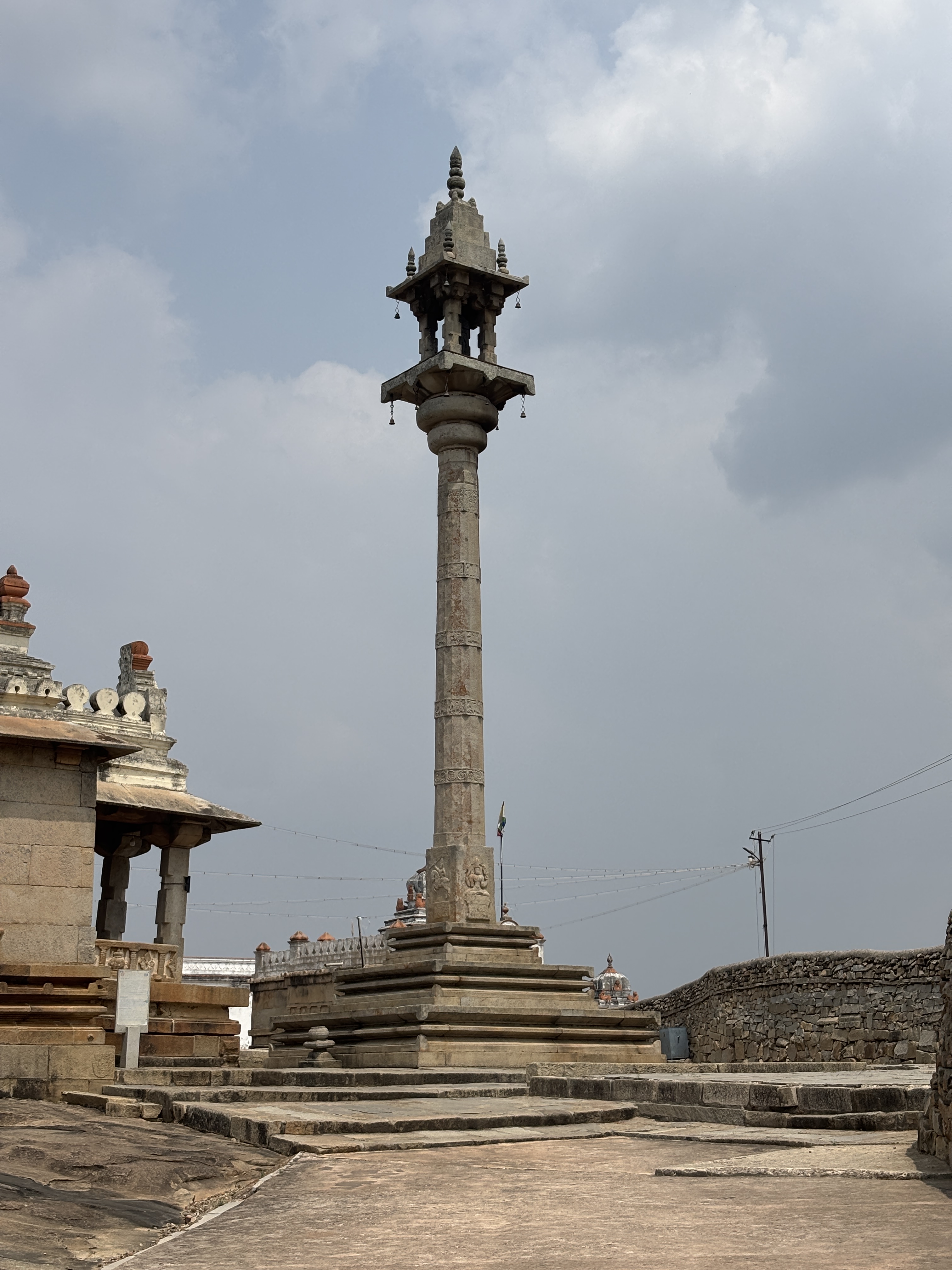
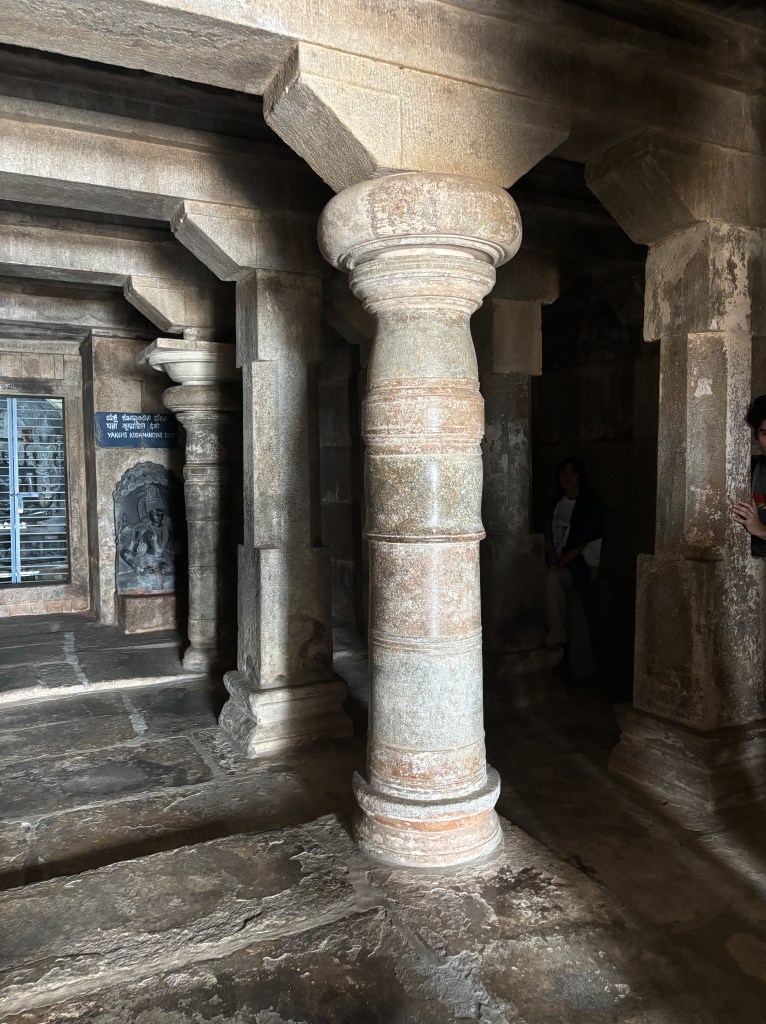
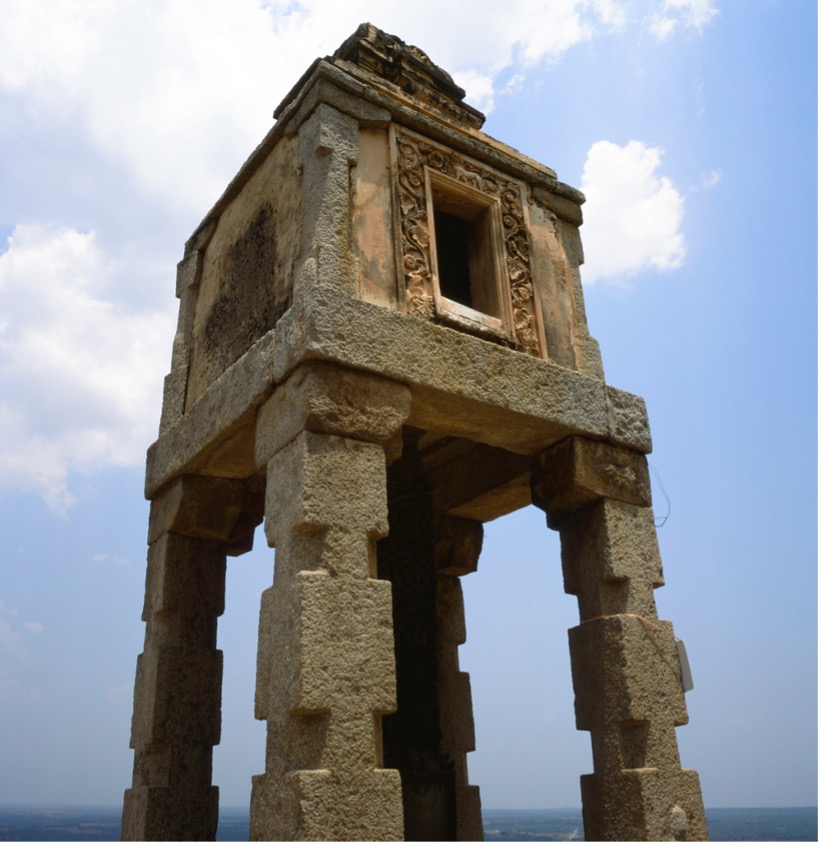
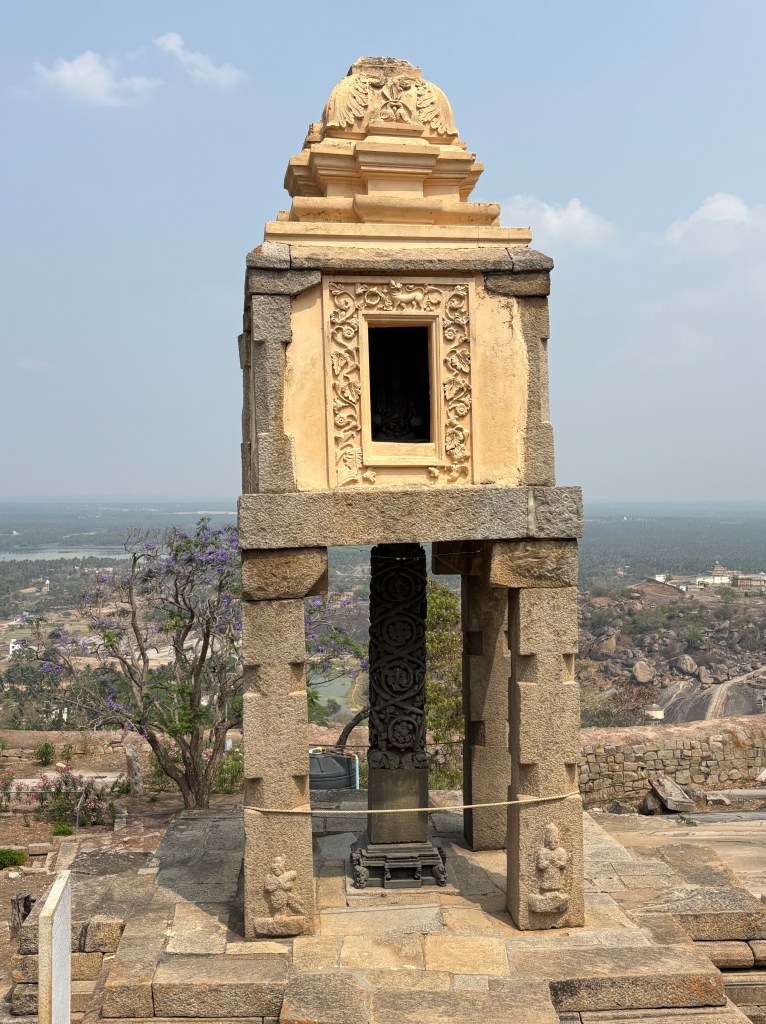
Climbing this slightly smaller hill, the first site that greets the visitor is the Kuge Brahmadeva Pillar, a wonder of ancient engineering with its significantly top-heavy decoration balancing precariously on the single stone shaft.
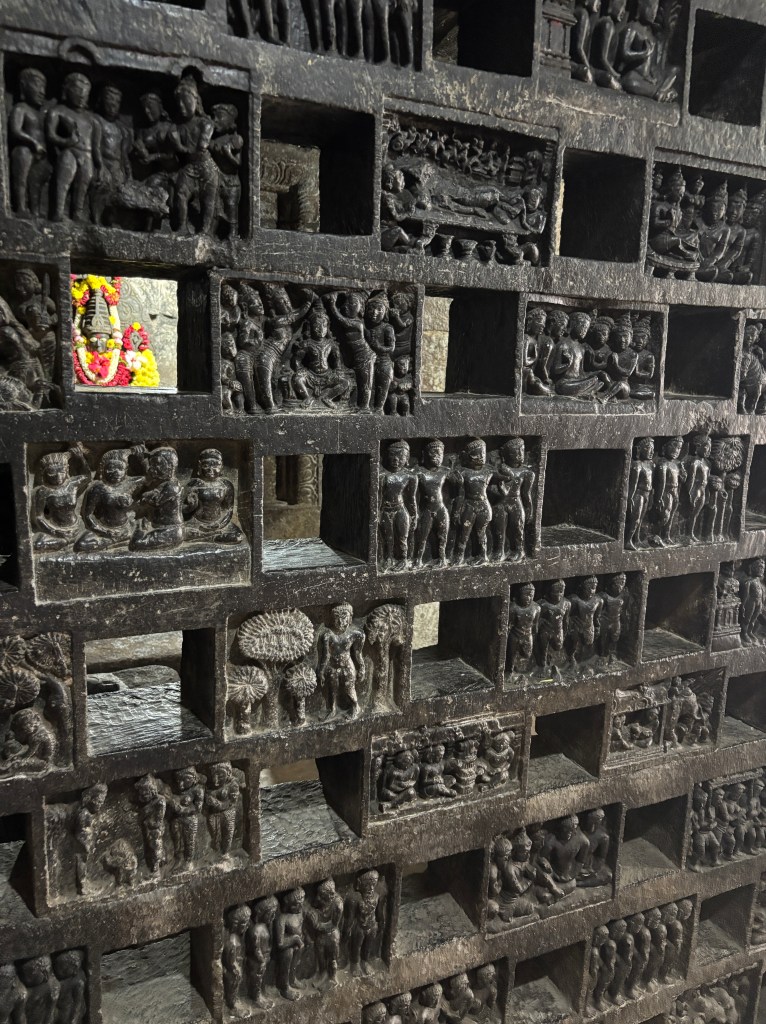
Of the several interesting structures on the smaller hill, the most significant of these temples is the Chandragupta Basti, erected by Emperor Chandragupta Maurya. Inside the Basti, there is a perforated stone screen pierced with square openings in ten rows. The interspaces, forty-five on each, are carved with minute scenes from the lives of the Emperor and his famous Jain teacher. It’s a masterwork, and well worth the climb up the stout hill.
There are four Jinalayas (Jain Temples) on larger hill called Vindhyagiri , the first dated as early as 4th Century BCE. There are seven other Jain temples of interest besides the monolith. At the top of this hill we find the largest sculptural monolith in the world (sculpture carved from a single stone).
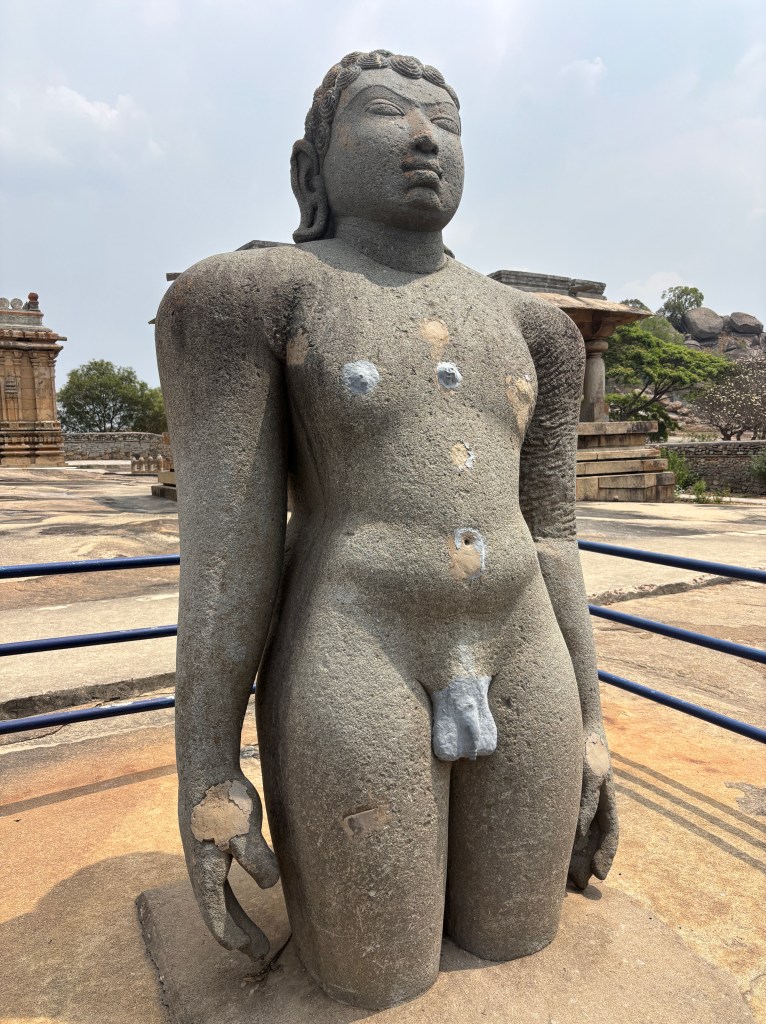
It was the General Chamundaraja (Commander-in-Chief of Chandragupta) who conceived carving the colossus, to chisel out in tangible form the intrinsic spirituality of the great Yogi Bhagawāna Bāhubali (Guru to the King, Chandragupta). The monolith has been carved from the natural peak of the solid rock of the hill. Largely unknown, I regard it as one of the wonders of the world. The stone monolith measures 57’ in height and was carved out of a great rock which stood on the top of the hill. The granite is fine-grained and light grey in color.
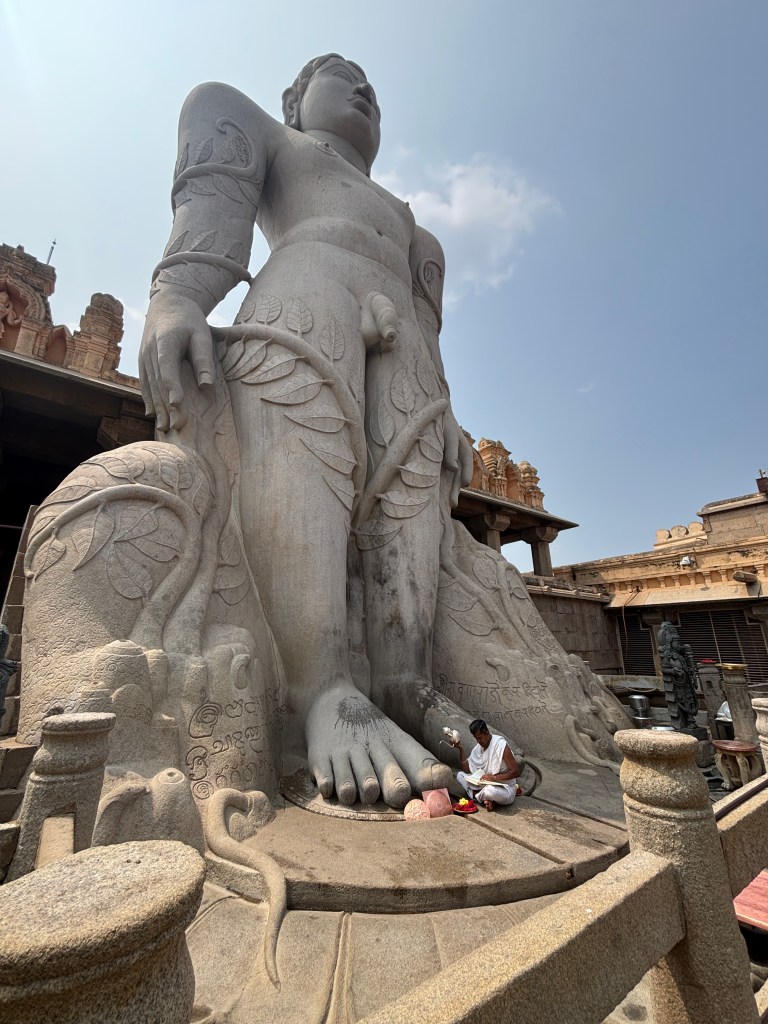
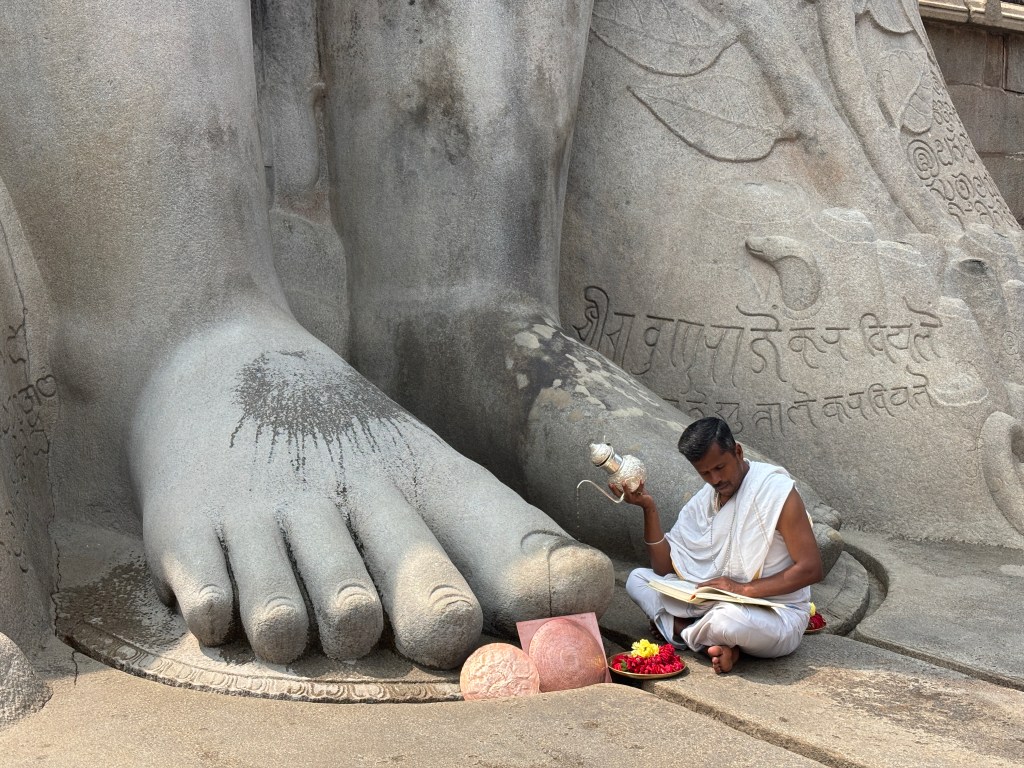
The story of Bāhubali (Guru to the King, Chandragupta), the naked Jain ascetic who is commemorated in this monolith, is long and complicated. But relevant to our appraisal of the sculpture as a world class work of art is the section of the story where his meditation finds traction. He becomes so skilled and immersed in Dhyānà (self-concentration) that he becomes entirely unconscious of the exterior world. An ant-hill grows up at his feet and creepers wound themselves around his arms and legs. He obtains absolute knowledge and becomes “the Omniscient.” It is said he “became a Perfect Soul and attained Nievānà.” Today, the sculpture is known as “Gommata,” which reportedly means the same thing as Bāhubali, a complicated derivation of “beautiful.”
It seems the inspiration for this sculpture might be a vivid description of Bāhubali that was composed by the great Kannada (aka Karnataka) poet Pampa in his masterwork titled Ādi-pirānà, written in 941 CE. Vilas A. Sangave writes in his book, The Sacred Shravanabelagola, (2017), 1981 (Chaer Dishayen, Noida, IN) from which I quote and borrow heavily for this essay, “In this popular work the poet Pampa had painted in words a truly magnificent picture of Bāhubali.”
Although there is no inscription by the artist who lead the carving team, there are several unsubstantiated claims that a Jain monk named Arusha-Nemi was the sculptor of the image, completed in 980 CE. Since the tradition of signing masterworks in India dates from at least 550 CE (as I will discuss in the next essay from the ancient site at Badami), this oral preservation of the lead artist’s name is certainly credible. It’s may be of interest to learn that artists and master masons in Europe did not sign their work until the 12th century CE. I puzzle on what that says about the slow rise of the individual in the West, as a separate and distinct agent of culture.
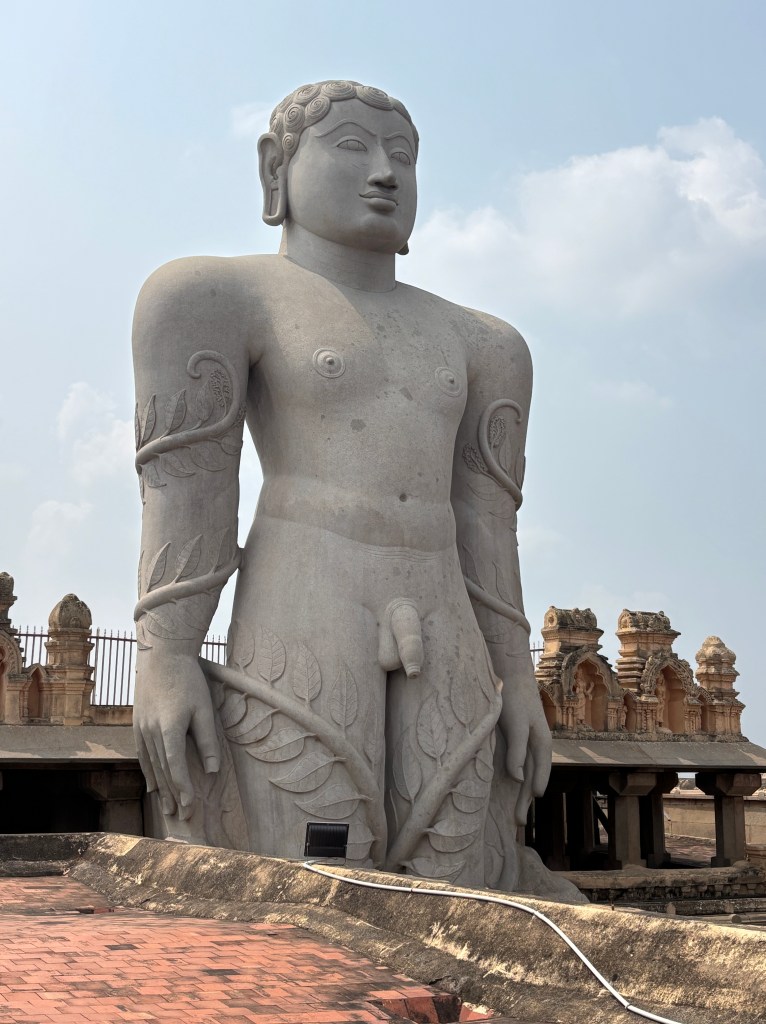
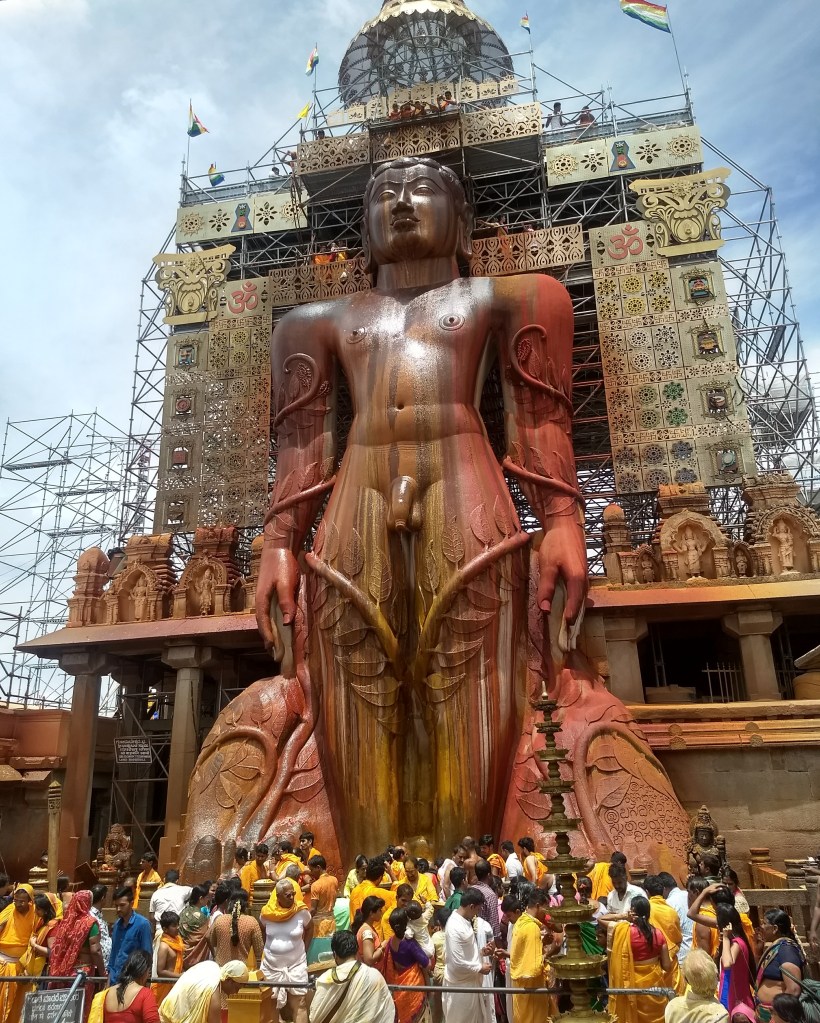
The sculpture has been ritually washed and cleansed on a regular basis since its consecration in 980 CE. In current times, this ritual ceremony occurs every 12 years. The next festival will take place in 2030 and, if the last ceremony in 2018 is any guide, will attract millions of Jain faithful. The sculpture is cleansed with a mix of purified water and sandalwood paste, poured over the statue from a scaffolding. The event continues for weeks. As the Mahamastakabhisheka begins, consecrated water is sprinkled onto the participants by devotees carrying 1,008 specially prepared vessels (kalashas). Additional libations such as milk, sugarcane juice, and saffron paste are used. The monolith is also sprinkled with powders of sandalwood, turmeric and vermilion.
 Bike Touring India
Leave a comment